What is data driven decision making: A Practical Guide to Smarter Growth
Data-driven decision making (DDDM) is really just a fancy way of saying you’re using hard facts to guide your business, not just your gut. For an e-commerce brand, this is the difference between guessing which products will sell and knowing what’s already working.
From Gut Feel to Growth Engine
Imagine you’re trying to navigate a ship through a storm. Relying on intuition is like using an old compass; you’ve got a general sense of direction, but you’re completely blind to the rocks just below the surface and the squall forming on the horizon.
Data-driven decision making is like upgrading to a full suite of modern navigation tools—GPS, weather radar, and sonar. Suddenly, you have a crystal-clear, real-time picture of where you are, where you’re going, and what obstacles to steer around.
This shift from guesswork to evidence isn’t a niche advantage anymore; it’s fast becoming the price of entry for success in the UK e-commerce scene. The market for data and analytics is expected to hit a staggering £42 billion globally by 2025, and British companies are getting on board. In fact, 81% of organisations now lean on analytics for their big decisions, and 89% of UK executives are planning to pump more investment into it over the next three years. If you’re serious about your business, understanding how to apply data is fundamental, especially when building out your strategy for digital marketing for ecommerce.
Why the Shift Is Happening Now
This isn’t about getting lost in spreadsheets. It’s about creating a systematic process for answering your most important business questions and making smarter choices that directly fatten your bottom line. The competitive edge you get is just too big to ignore.
This infographic paints a pretty clear picture of the benefits for companies that truly embrace a data-driven culture.
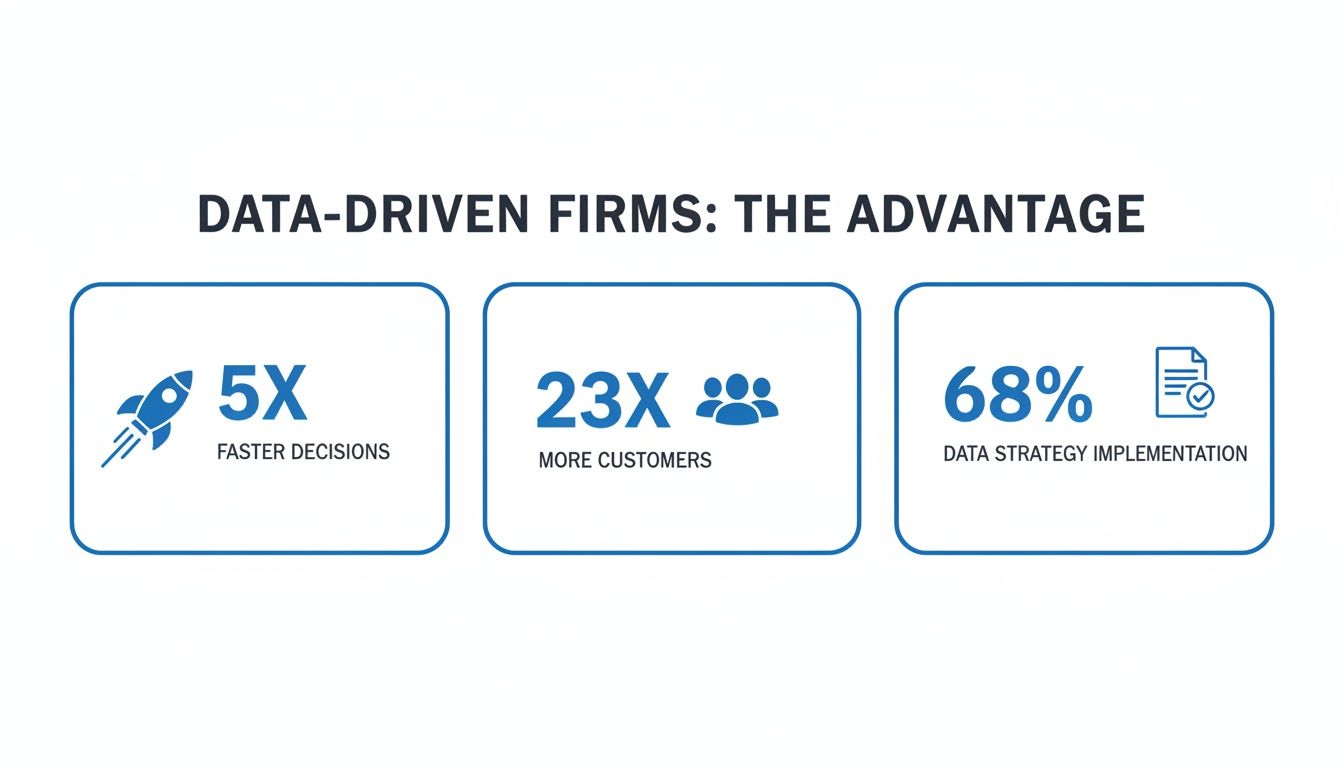
As you can see, organisations with a strong data culture make decisions five times faster than their peers and are a mind-boggling 23 times more likely to acquire new customers. It’s a game-changer.
Gut Feel vs Data-Driven: The E-Commerce Shift
So, what does this actually look like day-to-day? The contrast between a traditional “gut feel” operation and a data-driven one is stark. It changes everything from how you stock your warehouse to where you spend your marketing pounds.
“Relying on ‘what feels right’ wastes resources and makes proving marketing’s value an uphill battle. Data-driven decision-making offers a different path. It’s not about replacing intuition but refining it—backing bold ideas with clarity, precision and measurable outcomes.”
The table below breaks down this shift. It shows how moving from instinct to insight transforms everyday choices into real strategic advantages across common e-commerce tasks.
Gut Feel vs Data-Driven The E-Commerce Shift
| Business Area | Traditional ‘Gut Feel’ Approach | Data-Driven Approach |
|---|---|---|
| Product Launches | ”This new flavour feels like a winner. Let’s order 10,000 units." | "Our ad tests show a 3x higher click-through rate on this flavour. Let’s start with a 5,000-unit production run and monitor initial sales velocity.” |
| Marketing Budget | ”Let’s put more money into Instagram; it seems to be where our customers are." | "Our data shows a 25% higher customer lifetime value from Google Ads traffic. Let’s reallocate 15% of the budget from Instagram to scale our top-performing search campaigns.” |
| Inventory Management | ”We’re low on the blue jumpers. Better order more of everything to be safe." | "Sales velocity for blue jumpers is up 40% week-on-week, while red is down 15%. We’ll reorder 500 blue units and hold off on red until we clear existing stock.” |
| Customer Experience | ”A few customers complained about shipping. It’s probably a one-off issue." | "Our support tickets show a 30% spike in ‘late delivery’ queries from the Manchester area. Let’s investigate our local courier partner’s performance immediately.” |
Ultimately, the data-driven approach doesn’t eliminate the need for smart, creative thinking. It just makes sure that creativity is pointed in the right direction, backed by evidence that gives it the best possible chance to succeed.
Why Data Is Your E-commerce Superpower

Understanding data-driven decision making in theory is one thing. Watching it completely transform your profit and loss statement is another. This is where the concept stops being a buzzword and becomes a real competitive edge.
For an e-commerce brand, using data isn’t just about “modernising”—it’s about building a smarter, tougher, and more profitable business from the inside out.
Imagine you’re running ads across five different channels. The old way? Spread your budget evenly and cross your fingers. The data-driven way? You discover one of those channels is quietly bringing in customers who spend twice as much over their lifetime. That’s the superpower. It turns marketing from a hopeful expense into a calculated investment.
Lower Your Customer Acquisition Costs
One of the first, most tangible benefits of a data-driven approach is getting crystal clear on your marketing performance. You stop guessing which ads are working and start knowing which campaigns, channels, and even specific ad creatives are delivering profitable customers.
This means you can calculate your Customer Acquisition Cost (CAC) for each channel with surgical precision. By seeing what’s underperforming, you can cut the dead weight and reallocate that budget to scale what’s already a proven winner. The result is a much more efficient marketing engine that brings in more customers for the same money—or even less.
- Before Data: Splitting a £5,000 monthly ad budget across Meta, Google, and TikTok because it “feels right.”
- After Data: Finding out that Google Ads brings in customers with a 30% lower CAC, which prompts you to shift £2,000 from the other platforms to double down on your most profitable channel.
Boost Your Customer Lifetime Value
Getting the first sale is only half the battle. Real, sustainable profitability comes from keeping those customers around. Data gives you a map of the entire customer journey, not just the first purchase. When you start analysing buying habits, you can spot the hidden patterns that lead to a higher Customer Lifetime Value (LTV).
For example, your data might reveal that customers who buy a specific skincare product are 70% more likely to purchase a related serum within the next 45 days. Armed with that knowledge, you can build a targeted email flow or show them a personalised product recommendation that nudges them towards that second sale. You’re no longer hoping for repeat business; you’re engineering it.
A data-driven approach lets you shift from reactive problem-solving to proactive opportunity-seeking. You stop asking, “What just happened?” and start asking, “What can we make happen next?”
Optimise Every Corner of Your Operation
The impact of data ripples out far beyond your ad accounts. It touches every critical part of your e-commerce business, driving efficiency and protecting your margins at every step.
Smarter Inventory Management What if you could predict your next bestseller instead of just reacting to it? By analysing sales velocity and market trends, you can forecast demand with much greater accuracy. This helps you dodge two of the costliest mistakes in e-commerce:
- Painful Stockouts: Missing out on sales during a peak moment because you didn’t order enough product.
- Profit-Draining Overstock: Tying up cash in slow-moving inventory that you’ll eventually have to discount heavily just to get rid of it.
Higher Conversion Rates Data from A/B tests on your product pages, checkout flow, or even email subject lines gives you definitive proof of what works. A simple experiment might show that changing the colour of your “Add to Cart” button lifts conversions by 5%. On its own, that seems small. But these incremental gains stack up over time, adding a significant boost to your overall revenue without you having to spend a penny more on traffic.
Ultimately, all these benefits—lower CAC, higher LTV, optimised inventory, and better conversion rates—all feed into the one metric that matters most: overall profitability. Data is the connective tissue for your business, making sure every decision you make is aligned with the goal of building a stronger, more successful brand.
The Three Pillars of Smart Decision Making
Adopting a data-driven culture can feel like a huge undertaking, but it doesn’t have to be. Instead of trying to boil the ocean, you can build a solid foundation by focusing on three core pillars: People, Processes, and Platforms.
Think of it like building a house. You can have the best materials in the world, but without a skilled crew (People), a solid blueprint (Processes), and the right power tools (Platforms), you’re just left with a pile of lumber and a lot of frustration.
True data-driven decision-making happens when these three elements are in sync. You need curious people asking tough questions, repeatable processes to turn answers into action, and the right tech to make it all happen smoothly. Let’s break down each one.
The People Pillar: Fostering a Culture of Curiosity
The most sophisticated analytics platform on the planet is worthless if your team isn’t asking questions of it. The ‘People’ pillar is all about nurturing a culture where curiosity is the default setting and every team member feels empowered to hunt for answers in the data, not just in their gut.
This kind of shift has to start at the top. When leaders are seen using data to make their own choices—and are brave enough to admit when the numbers challenge their own assumptions—it sends a powerful message. It shows that evidence is valued over ego. The goal is to find the right answer, not just to be right.
To build this culture, you should:
- Encourage the “Why” questions: Create an environment where it’s safe and normal to ask, “Why did that campaign actually work?” or “Why are Londoners buying this flavour more than Mancunians?”
- Celebrate the data-driven wins: When a decision based on data leads to a great outcome, shout about it. This reinforces the value of the approach and gets others excited to try it.
- Provide accessible training: You don’t need a team full of data scientists. Invest in training that helps everyone understand the key metrics that drive your business. This gives them the confidence to use data in their day-to-day roles.
The Process Pillar: Turning Insight into Action
A brilliant insight is useless if it dies in a spreadsheet. The ‘Process’ pillar is all about creating simple, repeatable routines that ensure data consistently informs how you operate. It’s about building the “muscle memory” for data-driven action across your entire organisation.
These processes don’t need to be complicated. A simple weekly performance check-in can be incredibly powerful. By regularly reviewing key metrics, your team starts to spot trends, notice oddities, and make small, continuous adjustments that add up to significant growth over time.
A well-defined process is the bridge between raw data and real business results. It ensures that insights don’t just stay on a dashboard but are actually translated into concrete actions that improve performance.
Effective processes might include a monthly review of customer lifetime value by acquisition channel, or a pre-launch checklist that requires A/B test results before a new product goes live. The goal is to weave data into your existing workflows, making it a natural part of how you get things done.
The Platforms Pillar: Unifying Your Tech Stack
Finally, you need the right tools. The ‘Platforms’ pillar refers to the technology that collects, organises, and makes sense of your data. For most e-commerce brands, this means foundational tools like Shopify, Google Analytics, and various ad platforms like Meta and Google Ads.
But here’s the problem: each platform tells its own version of the story. This often leads to conflicting numbers and a deep-seated lack of trust in the data. The key is to have a central hub that pulls these separate sources together into a single source of truth.
This is where cloud-based analytics platforms are changing the game. In the UK, this shift is happening fast, with cloud solutions expected to capture 64% of the business intelligence market by 2025. This move to the cloud allows businesses—especially the small and medium enterprises that make up 99.9% of the UK economy—to access powerful tools without a massive upfront investment. You can read more about this trend and its impact on the UK market.
For a modern e-commerce brand, this central hub is increasingly powered by an AI analyst like Menza. Instead of wrestling with complex dashboards, it acts as the intelligent glue binding your people, processes, and platforms together.
By connecting all your data sources, a tool like this makes complex information accessible to everyone, turning your well-defined processes into a reliable engine for growth.
Data-Driven Decision Making in Action
Theory is one thing, but the real magic of data-driven decision making happens when you see it solve actual business problems. Let’s move past the frameworks and look at how real e-commerce brands use data to turn scary challenges into profitable opportunities.
These aren’t stories about complicated algorithms or huge data science teams. They’re about asking the right questions, looking at the right numbers, and having the courage to act on what the data tells you. Each example shows a simple, powerful process: a question was asked, data provided an answer, a decision was made, and a clear result followed.
Story 1: Optimising Marketing Spend
First up, a direct-to-consumer brand was staring down a common but terrifying problem: their return on ad spend (ROAS) was in a nosedive. Panic was setting in. The gut reaction might have been to slash the entire marketing budget or frantically launch new, unproven campaigns.
The Question: Instead of guessing, they asked a much smarter question: “Which specific campaign or channel is killing our overall profitability?”
The Data: They dug into their advertising data, connecting their spend from Meta and Google Ads with their sales figures from Shopify. The numbers didn’t lie. A single, high-spending Meta Ads campaign was generating tons of clicks but almost zero conversions. It was a budget black hole, burning cash while a high-performing Google Ads campaign was starved for more investment.
The Decision: The choice became obvious. They immediately shut down the underperforming Meta campaign and funnelled the entire budget into scaling their proven winner on Google Ads.
The Result: The impact was almost instant. With marketing spend now focused exclusively on a profitable channel, the brand’s overall ROAS rebounded within a week. They turned a nail-biting situation into a clear win for the bottom line.
Story 2: Smarter Inventory Planning
Our second example is a fashion brand heading into the all-important winter season. In previous years, they’d struggled with inventory, either ordering way too much of the wrong styles or selling out of popular items long before the cold weather ended.
The Question: This year, they wanted to get ahead of the game. They asked: “Which specific products are showing the strongest early demand, signalling they will be our winter bestsellers?”
By analysing sales data, the brand could move from reactive reordering to proactive forecasting. This simple shift is a cornerstone of what data-driven decision making is all about—using past performance to make better future choices.
The Data: The team analysed their sales velocity data, tracking how quickly specific items were selling in the early autumn. A clear trend emerged: one particular style of wool coat was selling 40% faster than any other item in their new collection, even with minimal promotion. This was a powerful signal of organic demand.
The Decision: Armed with this evidence, they confidently placed a much larger wholesale order for that specific coat, while slightly trimming their orders for slower-moving items.
The Result: When the first major cold snap hit, they were perfectly stocked. The coat became their seasonal bestseller, and they avoided a costly stockout during their peak shopping period, maximising both sales and profit margins. Getting this right is crucial, and you can learn more about how to analyse Shopify data to boost e-commerce growth in our detailed guide.
Story 3: Reducing Customer Churn
Our final story is about a subscription box business struggling with customer retention. They had a classic “leaky bucket” problem—new subscribers were signing up, but far too many were cancelling after just a few months.
The Question: To fix the leak, they had to find its source. They asked: “Is there a common behaviour or characteristic among the customers who cancel in their first three months?”
The Data: They dug into their churn data, layering it with customer behaviour information from their platform. A surprising insight jumped out. Customers who never used the ‘skip a month’ feature within their first three months were overwhelmingly more likely to cancel their subscription outright. This suggested that new users didn’t fully grasp the service’s flexibility and felt locked in.
The Decision: Based on this insight, they launched a simple, automated email campaign. The email was sent to all new subscribers during their second month, specifically educating them on how easy it was to skip a delivery if they needed a break.
The Result: This small, data-informed change had a huge impact. By proactively addressing this hidden friction point, they reduced their early-stage churn rate by 15%, significantly boosting their customer lifetime value.
How to Avoid Common Data Pitfalls
Jumping into data-driven decision-making isn’t like flipping a switch. It’s a journey, and along the way, most e-commerce brands stumble into the same few ditches. The good news is, they’re predictable. Seeing them coming is the first step to steering clear.
These challenges aren’t really about tech; they’re about people. We get overwhelmed by complexity, we lose trust in the numbers, or we’re just plain scared of getting it wrong. But for every one of these roadblocks, there’s a practical way around it.
The Problem of Data Overload
One of the first things I hear from founders is that they feel like they’re drowning in data. They’ve got dozens of dashboards and hundreds of metrics, but instead of feeling empowered, they just feel stuck. This is data overload. It leads to paralysis because you have no idea where to even start looking.
The answer isn’t more data—it’s less noise. Forget tracking every metric under the sun. Instead, zero in on the handful of Key Performance Indicators (KPIs) that actually move the needle for your business. For a DTC brand, that’s almost always Customer Acquisition Cost (CAC), Customer Lifetime Value (LTV), and Conversion Rate. Focusing on these core numbers gives you direction and turns data into something you can actually use.
When you’re drowning in numbers, you’re not data-driven; you’re data-distracted. The goal is to find the few signals that matter amidst the overwhelming noise of modern analytics.
By prioritising a small set of vital metrics, you give your team a compass. Every decision can be weighed against its impact on these critical numbers, turning a confusing sea of charts into a clear path forward.
The Danger of Dirty Data
Ever pulled a sales report from Shopify that says one thing, only to see completely different numbers in Google Analytics? That’s dirty data, and it’s a silent killer. When your team can’t trust the numbers, they’ll inevitably fall back on gut feelings and old habits.
Conflicting data doesn’t just erode confidence; it leads to flat-out bad decisions. The problem usually stems from not having a single, unified view of the business. Each platform measures success in its own way, creating a fractured, unreliable picture. This is why establishing strong data governance best practices is non-negotiable for any brand that wants to scale.
To fix this, you need to establish a single source of truth. This means using a central platform that pulls in data from all your key tools—your e-commerce store, ad platforms, and analytics software—and stitches it all together. When everyone in the company is looking at the same consistent numbers, trust comes back, and decisions become aligned.
The Trap of Analysis Paralysis
The last major pitfall is analysis paralysis. This is what happens when the fear of making the wrong call stops you from making any call at all. You just keep slicing and dicing the data, waiting for the 100% certainty that will never arrive. All the while, your competitors are moving, and opportunities are slipping away.
It’s crucial to remember that data is here to reduce uncertainty, not to eliminate it completely. Making a good decision with 80% confidence is infinitely better than making no decision at all while you wait for perfect information that doesn’t exist.
Modern tools, especially AI analysts, are built to break this cycle. Instead of just giving you more confusing dashboards to interpret, they deliver clear, plain-English answers to your questions. By automating the data cleanup and analysis, they take the friction and fear out of the process, helping you move from insight to action with speed and confidence.
Putting Your Data to Work with an AI Analyst
You’ve seen what data-driven decision making can do, but let’s be honest, getting there has always been a pain. The old way involved hiring expensive data analysts or forcing your team to fight with complicated business intelligence software. For anyone running an e-commerce business, neither option is realistic.
This is where the game is changing. A smarter, more direct approach is taking over, powered by a new kind of tool: the AI data analyst.
Think of a tool like Menza not as another dashboard to stare at, but as a strategic partner built for the speed and chaos of e-commerce. It plugs directly into all the platforms you already use—Shopify, Meta Ads, Google Analytics, and more—to build a single, reliable view of your business. That alone solves the ‘dirty data’ problem we talked about earlier.
Asking Plain-English Questions
The real breakthrough is how you get information out. Instead of needing to know code or navigate endless menus, you just ask questions. In plain English.
Imagine logging in and just typing:
- “Why did our sales dip last Tuesday?”
- “Which marketing channel brought in the most profitable customers last month?”
- “What’s the sales velocity for our new product line?”
An AI analyst understands these questions, crunches your real-time data, and gives you an instant, actionable answer. It removes the technical wall that has kept powerful insights away from the people who actually need them. When thinking about where to start, exploring the most effective AI SEO tools can be a practical first step to applying these data-driven principles to your visibility.
The point of modern analytics isn’t to turn marketers into data scientists. It’s to give them the answers they need to make smarter decisions, faster. An AI analyst finally closes that gap.
This shift towards accessible AI is picking up pace across the UK. In 2023, only 9% of UK firms were using AI, but that number was projected to rocket to 22% in 2024. The most common use? Data processing with machine learning. That tells you a critical window to gain an edge is opening right now.
Proactive Monitoring for Your Business
Maybe the most valuable thing an AI analyst does is work when you’re not. While you’re busy running the business, it’s monitoring your data 24/7, acting as a vigilant watchdog for all your key metrics.
Instead of you having to find problems, the problems find you—in the form of a clear, concise alert. This turns your data from a rearview mirror into a real-time defence system. For a deeper look at this, you might find our guide on the role of AI for business intelligence useful.
Here’s what that looks like in the real world:
- Sudden Ad Overspending: The AI sees a Meta campaign has burned through 80% of its daily budget by 9 AM with hardly any conversions and pings you immediately.
- Impending Stockouts: It flags a sudden sales spike for a key product and calculates that you’ll be out of stock in three days, giving you time to reorder.
- Conversion Rate Drops: It spots a nosedive in your checkout conversion rate and pinpoints that the issue is only affecting mobile users, helping you find and fix the bug in minutes, not days.
This is the evolution of data-driven decision making. It’s no longer about just looking at what happened last month. It’s about having an always-on partner that makes powerful insights accessible to everyone and helps you solve tomorrow’s problems today.
Got Questions About DDDM?
Making the switch to a data-driven culture always brings up a few practical questions. Here are some straight answers to the most common ones I hear from growing e-commerce brands.
Where Do I Start If My Team and Budget Are Small?
Start small, but be specific. Don’t try to analyse everything at once. Pick a single, important business question you want to answer. A great starting point is something like, “Which of our marketing channels is actually bringing in our best customers?”
You don’t need fancy tools for this. Use the free analytics you already have, like Shopify Analytics or Google Analytics 4. The goal isn’t to boil the ocean; it’s to build the simple habit of asking a question and then looking at the data to find an answer.
Do I Have to Be a Data Scientist to Make This Work?
Absolutely not. That’s the old way of thinking. Modern tools, especially AI analysts, are built for business users, not coders. The most valuable skill today isn’t writing complex queries, it’s knowing how to ask smart business questions.
The new generation of analytics technology does all the heavy lifting behind the scenes. That frees you up to focus on what you do best: thinking about strategy and taking action.
How Can I Be Sure My Data Is Accurate and Trustworthy?
This is a huge one, and it’s a valid concern. The key to getting insights you can actually rely on is to establish a ‘single source of truth.’
Stop the slow, error-filled process of manually exporting data into spreadsheets. Instead, use a platform that connects directly to your core systems—like Shopify, Google Ads, and Meta—to pull everything automatically. This ensures your numbers are consistent, reliable, and always current, giving you a trustworthy foundation for every decision you make.
Ready to stop guessing and start knowing? Menza is the always-on, AI-powered analyst that connects to your entire tech stack, giving you trustworthy answers in plain English. Get started with Menza today.
Stop guessing. Start knowing.
Menza connects to your Shopify, Klaviyo, ad platforms, and 650+ other data sources. Ask questions in plain English and get answers you can trust — no spreadsheets, no code, no waiting.