What Is Customer Segmentation A Guide to Unlocking Growth
Customer segmentation is really just a straightforward idea: breaking down your entire customer base into smaller, more manageable groups. Instead of blasting the same message to everyone, you group people together based on what they have in common.
This lets you fine-tune your marketing, your products, and even your customer service to fit the specific needs of each group. The result? Sharper communication and much stronger relationships with the people who buy from you.
Beyond One Size Fits All
Imagine walking into a crowded party and trying to have one single conversation that interests everyone at once. It’s impossible. You’d get tuned out immediately because the message wouldn’t be relevant to anyone in particular.
Marketing without segmentation is exactly like that—a lot of noise that doesn’t really connect. It’s impersonal, inefficient, and honestly, pretty ineffective. By splitting your audience into distinct groups, you can speak to them in a way that actually resonates.
The core principle is simple: not all customers are created equal. They have different budgets, different motivations, and completely different buying habits. Segmentation is how you recognise and act on those differences. You stop treating your audience like a monolith and start creating focused campaigns that solve the unique problems and speak to the desires of each group.
For any modern e-commerce brand trying to cut through the noise, this isn’t just a nice-to-have; it’s essential. It has a direct, measurable impact on the business:
- Better Marketing ROI: You stop wasting ad spend on audiences who were never going to convert anyway and focus your budget where it counts.
- Deeper Customer Loyalty: When customers feel like you “get” them, they stick around. It’s that simple. Personalisation builds connection.
- A Real Competitive Edge: Personalised experiences are no longer a surprise and delight feature; they’re the bare minimum customers expect. Segmentation is the engine that drives it all.
To give you a quick overview, here’s a simple breakdown of what customer segmentation is all about.
Customer Segmentation at a Glance
| Concept | Primary Goal | Key E-commerce Benefits |
|---|---|---|
| The practice of dividing a customer base into smaller groups based on shared traits. | To move from a “one-size-fits-all” approach to targeted, relevant engagement. | Increased marketing ROI, higher customer loyalty, and improved product development. |
This table captures the essence, but the real power comes from applying these ideas to your own business.
Understanding Your Audience in a Complex World
Knowing your customers has to go deeper than basic demographics like age and location. It means getting a handle on their real-world circumstances, especially when the economy is unpredictable.
For instance, 2022 research in the UK revealed that over 20 million people are in financially vulnerable situations. The study identified specific groups like the ‘Squeezed and Sliding’ segment—1.9 million families watching their savings dwindle as their debts grow.
Understanding these nuances means you can communicate with genuine empathy and offer solutions that actually help, rather than just sell. You can dig into the specifics of these financial segments in the full report.
Ultimately, segmentation turns your raw data into a strategic asset. It helps you pinpoint your most profitable customers, understand what they might be worth over time, and make smart calls on where to invest your resources.
A crucial metric here is Customer Lifetime Value (CLV), which helps you measure the total revenue you can expect from a single customer over their entire relationship with your brand. By grouping customers based on their potential value, you can focus your energy on keeping your best buyers happy. To get a better handle on this, check out our guide on how to calculate customer lifetime value.
The Four Core Types of Customer Segmentation
To really get a handle on your audience, you need a way to organise them. Think of customer segmentation less as a single task and more like a set of different lenses you can use to see your customer base with total clarity. The four core types of segmentation give you these foundational lenses, helping you move from a blurry, one-size-fits-all view to a sharp, focused picture.
These models are the building blocks of any solid strategy. They help you answer the big questions: who your customers are, where they live, why they buy, and how they actually behave. Once you get these four approaches down, you can start creating experiences that feel genuinely personal and relevant, which is what ultimately drives both engagement and sales.
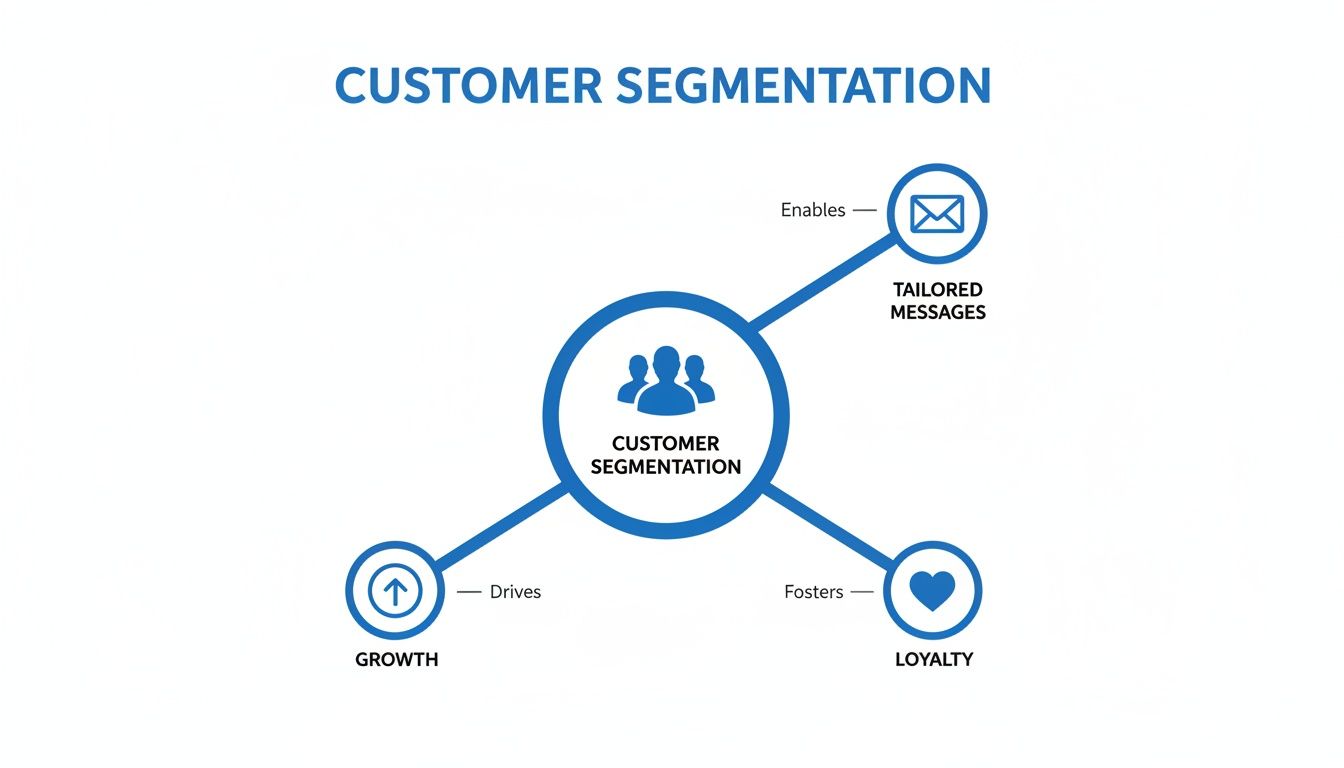
This is the core idea: segmentation isn’t just about putting people into boxes. It’s a strategic process that directly connects understanding your customers to getting better business results, like tailored messages that build real loyalty and growth.
Let’s break down each of these lenses.
Demographic Segmentation: Who They Are
Demographic segmentation is almost always the first and most straightforward place to start. It groups customers based on objective, statistical data—the basic “who” of your customer base.
This kind of data is usually easy to get your hands on, making it a perfect entry point for any business trying to make sense of its audience.
Common demographic details include:
- Age: Are you selling to Gen Z, Millennials, or Boomers?
- Gender: Does your product resonate more with men, women, or a non-binary audience?
- Income: Are your customers high-earners or more budget-conscious shoppers?
- Education Level: Does their academic background influence what they buy?
- Occupation: Are you targeting students, working professionals, or retirees?
A fashion brand, for example, might use this data to push its trendy streetwear collections to a younger audience with TikTok ads, while running Facebook campaigns for its classic, elegant pieces aimed squarely at an older demographic. This isn’t just theory; UK retail data proves how vital this is. A 2023 report showed 45% of Millennials do most of their shopping online, more than any other group, while 69% of Boomers still prefer physical shops. That one statistic shows exactly why a brand must segment its channel strategy by age to have any chance of success.
Psychographic Segmentation: Why They Buy
While demographics tell you who your customers are, psychographics get to the heart of why they do what they do. This model dives into the less tangible, psychological side of your audience.
It’s all about their internal motivations, their values, and their beliefs. Getting a grip on this “why” allows you to craft marketing messages that don’t just sell, they connect.
Psychographic segmentation is about connecting with customers on an emotional level. It’s the difference between selling a coat and selling warmth, comfort, and a sense of style.
Key psychographic variables include:
- Lifestyle: Are they urban adventurers, dedicated homebodies, or fitness fanatics?
- Values and Beliefs: Do they care deeply about sustainability, ethical sourcing, or social causes?
- Interests and Hobbies: What do they love doing in their spare time?
- Personality Traits: Are they risk-takers, cautious planners, or the first to jump on a new trend?
A wellness company could use this to find eco-conscious consumers, hitting them with messages that shout about their sustainable packaging and organic ingredients. Digging into specific approaches like Psychographic Segmentation helps you build a brand identity that truly aligns with what your customers believe in, which is how you build unshakable loyalty.
Behavioural Segmentation: What They Do
Behavioural segmentation groups customers based on their direct interactions with your brand. It doesn’t care who they are or what they think; it’s purely about what they do.
For e-commerce, this is arguably the most powerful segmentation type because it’s based on tangible actions. That makes it incredibly good at predicting what someone might do next.
Common behavioural data points are:
- Purchase History: Are they first-time buyers, loyal repeat customers, or have they gone quiet?
- Spending Habits: Do they splurge on high-ticket items or hang back waiting for a sale?
- Product Usage: How often do they actually use your product?
- Website Engagement: Which pages do they visit? Do they constantly abandon their carts?
Imagine an online bookstore. It can create a segment of customers who recently bought science fiction novels and ping them a targeted email about a new release from a big-name sci-fi author. This simple, behaviour-based move dramatically increases the odds of a sale.
Geographic Segmentation: Where They Are
Finally, geographic segmentation groups customers based on their physical location. This can be as broad as countries and continents or as specific as cities, postcodes, or even climate zones.
It’s a simple model, but it can be incredibly effective, especially if your products or marketing are influenced by location.
A clothing retailer, for instance, would use this to promote heavy winter coats to customers in Scotland while pushing swimwear to shoppers in Cornwall during the same month. It’s common sense, really. It ensures your marketing budget is spent on showing people things they might actually want, preventing your brand from looking completely out of touch with their daily reality.
Comparing Customer Segmentation Models
To make this crystal clear, here’s a quick breakdown of how these four core models stack up. Each one uses different data to answer a different question, giving you a unique angle for your marketing.
| Segmentation Type | Data Used | E-commerce Use Case Example |
|---|---|---|
| Demographic | Age, gender, income, occupation | A luxury skincare brand targets high-income women aged 35-55 on Instagram. |
| Psychographic | Lifestyle, values, interests, personality | An outdoor gear company targets “adventure seekers” who value sustainability. |
| Behavioural | Purchase history, website clicks, cart abandonment | A coffee subscription service emails a special offer to customers who haven’t ordered in 90 days. |
| Geographic | Country, city, postcode, climate | A fashion retailer promotes raincoats to users in Manchester and sunglasses to users in Brighton. |
While each of these models is powerful on its own, the real magic happens when you start layering them together. A “high-income woman in London who values sustainability and has previously purchased anti-ageing products” is a much richer, more actionable segment than any one of those attributes alone.
Using Advanced Models for Deeper Customer Insights
 Once you’ve got a firm grip on the foundational types of segmentation, you can start unlocking a much deeper level of understanding. This is where we move beyond static traits like demographics and start focusing on the dynamic value and behaviour of customers over time. These advanced models give you a strategic roadmap, showing you precisely where to focus your marketing efforts for the greatest impact.
Instead of just knowing who your customers are, these models help you understand their real value to your business. This is the key. It’s how you shift from broad, scattergun campaigns to highly targeted actions that build long-term relationships and drive proper, sustainable growth.
Pinpoint Your Best Customers with RFM Analysis
One of the most effective advanced models out there is RFM analysis, which stands for Recency, Frequency, and Monetary value. It’s a deceptively simple, yet powerful way to identify your best customers by answering three questions:
- Recency: How recently did this customer make a purchase?
- Frequency: How often do they buy from you?
- Monetary: How much do they spend?
By scoring each customer on these three factors, you can create incredibly useful segments. For example, customers who score high on all three are your “Champions”—they buy often, spend a lot, and have done so recently. On the other hand, a customer with low recency but high frequency and monetary scores might be a “Loyal Customer at Risk.” They love your products, but they need a gentle nudge to come back.
This approach transforms your raw sales data into actionable intelligence. Suddenly, you know exactly who to reward with VIP perks and who needs a carefully crafted win-back campaign.
Nurture Relationships with Lifecycle Stage Segmentation
Let’s be honest: not every person interacting with your brand is a paying customer yet, and not all paying customers are the same. Lifecycle stage segmentation acknowledges this reality by grouping people based on where they are in their journey with your business. It’s all about meeting them with the right message at the right time.
Think of it like a conversation. You wouldn’t propose marriage on a first date, and you shouldn’t ask a brand-new website visitor to become a brand advocate overnight.
Lifecycle segmentation is the art of tailoring your communication to match the maturity of your customer relationship. It guides them from prospect to loyalist, one relevant interaction at a time.
Common lifecycle stages include:
- New Subscribers: People who’ve just signed up for your newsletter but haven’t yet bought anything.
- First-Time Buyers: Customers who have made their first purchase and need to be encouraged to return.
- Repeat Customers: The core of your business—the people who make regular purchases.
- Loyal Advocates: Your most dedicated fans who not only buy but also promote your brand to others.
- At-Risk or Churned Customers: People who haven’t bought in a while and may be lost for good without intervention.
Each of these groups requires a completely different communication strategy. To manage these journeys effectively, many businesses rely on dedicated customer journey mapping tools to visualise and optimise every single touchpoint.
Focus on Profitability with Value-Based Segmentation
While RFM tells you who your best customers have been in the past, value-based segmentation aims to predict who will be most profitable in the future. This model often centres on Customer Lifetime Value (CLV), a metric that forecasts the total net profit your business can expect from a single customer over their entire relationship with you.
This approach is profoundly strategic. It helps you identify customers who may not spend a lot in a single transaction but whose consistent, long-term loyalty makes them incredibly valuable. By segmenting based on predicted CLV, you can justify investing more in acquiring and retaining these high-potential individuals.
This technique can even get more precise when you layer in external factors. For instance, understanding how outside events influence purchasing can seriously refine your value predictions. You can explore this concept further in our article about how to predict sales from weather and other variables.
By applying these advanced models, you move beyond basic analysis and start making proactive, data-informed decisions that fuel real growth.
Putting Customer Segmentation Into Action
Understanding the models is one thing, but a great strategy is useless if it just sits in a spreadsheet. The real value gets unlocked when you move from analysis to action—turning those carefully defined groups into real-world marketing campaigns that actually drive results. This is where the theory gets real.
It’s not about getting lost in endless data. It’s about creating a direct line from customer insight to business impact. The whole process can be broken down into a clear, repeatable framework.
Set Clear and Specific Goals
Before you touch a single line of data, you have to know what you’re trying to achieve. A segmentation project without a goal is just an academic exercise, and nobody has time for that. Your objective needs to be specific, measurable, and tied directly to a business outcome.
What’s the end game here? Are you trying to:
- Reduce customer churn by spotting at-risk shoppers and re-engaging them before they disappear?
- Increase customer lifetime value by getting your best customers to make another purchase?
- Improve conversion rates by personalising the experience for first-time visitors?
- Boost marketing ROI by focusing your ad spend on segments that are actually likely to buy?
Choosing a concrete goal, like “reduce churn among first-time buyers by 15% in the next quarter,” gives you a north star. It will guide every single decision you make from here on out.
Gather and Consolidate Your Data
With your goal defined, it’s time to wrangle the data. Your customer information is probably scattered all over the place, living in different tools that don’t talk to each other. The key is to pull it all together into a single, unified view of each person.
Your most common data sources will be:
- E-commerce Platform: Your Shopify or BigCommerce store holds the gold—transaction data like purchase history, order value, and the specific products people bought.
- Website Analytics: Google Analytics tells you what people do on your site, showing you behavioural data like pages visited, time on site, and where they came from.
- Email & SMS Platforms: Tools like Klaviyo give you engagement metrics such as open rates, click-throughs, and campaign interactions.
- CRM or Customer Service Tools: Systems like HubSpot or Zendesk contain a treasure trove of interaction history and direct customer feedback.
The sheer volume of this data can feel overwhelming, and that’s normal. The scale of modern business requires tools that can handle massive datasets without breaking a sweat. Just look at how HMRC segments UK taxpayers—we’re talking 35 million individual customers and 5.2 million small businesses. It shows just how critical scalable segmentation tools are. An AI analyst like Menza can connect to your HubSpot, databases, and spreadsheets to proactively spot trends across millions of records without needing a single line of code. You can learn more about how the government segments different customer groups for tax purposes.
Choose the Right Segmentation Model
Now, look back at your goal. The model you choose should be the most direct path to achieving it. Don’t overcomplicate things; pick the right tool for the job.
Your goal dictates the model. If you want to find your VIPs, use RFM. If you want to nurture new leads, use lifecycle stages. The trick is to match the method to the mission.
For instance, if your goal is to win back lapsed customers, a simple behavioural segment based on “customers who haven’t purchased in 90 days” is perfect. If you’re trying to increase repeat purchases, an RFM model that helps you identify your “Champions” and “Loyal Customers” is exactly what you need.
Activate Your Segments with Targeted Campaigns
This is the final and most important step. An insight is worthless until you act on it. Activating your segments means using these new groups to launch targeted, personalised marketing campaigns.
Here’s what that could look like in practice:
- Identify a segment: Let’s say you spot a “High-Potential” RFM segment—these are frequent, recent buyers who haven’t quite reached your top spending tier yet.
- Create a targeted offer: Forget generic discounts. Give them an exclusive early look at a new product collection or a special multi-buy offer designed to increase their average order value.
- Launch a multi-channel campaign: Don’t just send one email and hope for the best. Hit them with a personalised email, run a targeted ad on Meta that speaks directly to them, and show them a unique banner on your website when they visit.
By connecting your segments to your marketing platforms, you can automate these personalised experiences at scale. This ensures the right message reaches the right person at the right time. For a deeper dive on making your channels work together, check out our guide on linking Klaviyo with your advertising platforms. This is how a smart segmentation strategy turns into measurable growth.
Here’s the rewritten section, crafted to sound like an experienced human expert, following the provided style guide and examples.
Common Segmentation Mistakes and How to Avoid Them
Getting into customer segmentation is a huge step forward, but a few common pitfalls can turn a great idea into a confusing mess. I’ve seen it happen. Brands get excited, dive in headfirst, and end up with something that’s either too complicated to use or built on shaky ground.
The funny thing is, these mistakes usually come from good intentions. People want to be perfectly precise or use every last byte of data they have. But that’s not the point. The point is to create something useful. Let’s walk through the biggest traps and how to sidestep them.
Creating Too Many Segments
This is the classic “analysis paralysis” mistake. It’s tempting to slice your customer base into dozens of tiny, hyper-specific groups. You end up with segments like “left-handed, high-income customers in Manchester who buy on Tuesdays.” Sure, it’s precise. But what on earth do you do with that information?
Remember, the whole purpose of segmentation is to create groups you can actually talk to differently. If you have 50 segments, you need 50 different campaigns. No team I know can manage that effectively. It’s a recipe for burnout and zero results.
The Fix: Start simple. I always tell brands to begin with 3-5 broad, high-impact segments. Focus on the groups that represent big chunks of your audience and have obviously different needs. You can always get more granular later, once you’ve mastered the basics.
Relying on Outdated or Inaccurate Data
Your segments are only as good as the data they’re built on. It’s that simple. If you’re using old purchase history, incorrect contact details, or patchy behavioural data, you’re just making bad decisions faster. It’s a waste of time and money.
Customer behaviour changes. A “high-value” customer from two years ago might not have bought a single thing since. Targeting them with a “loyal shopper” campaign isn’t just irrelevant; it’s a surefire way to alienate them and make your brand look clueless.
The Fix: You need a system for keeping your data fresh and clean. That means connecting all your sources—your Shopify store, Google Analytics, your CRM, everything—into a single, up-to-date view of each customer. Automation is your best friend here. It ensures your insights are based on what’s happening now, not what happened a year ago.
Building Segments Without Clear Business Goals
This one happens more often than you’d think. A team creates segments just for the sake of it, without tying them to a specific business problem. You might find a fascinating group of “weekend shoppers,” but if you don’t know what you want them to do, the insight is completely useless. It’s a fun fact, not a strategy.
Every single segment you build needs to be connected to a measurable outcome. Are you trying to get them to buy more often? Increase their average order value? Stop them from churning? If you don’t have a goal, you have no way to measure success or justify the resources you’re spending.
The Fix: Define the objective first. Before you even think about building a segment, ask yourself: “What business problem are we trying to solve with this?” That question should guide your entire process. It ensures your work is focused on actions that actually move the needle on growth and profitability.
Turning Segmentation Insights Into Proactive Decisions
Defining your customer segments is a great start, but it’s only half the battle. The real magic happens when you embed that knowledge into your daily operations. The goal is to stop pulling reports after the fact and start building a business that proactively responds to what your customers are doing right now.
It’s about shifting from knowing who your customers are to knowing what they need, sometimes even before they do. Instead of reacting to a sales dip at the end of the month, you get a real-time alert that your ‘High-Value Repeat Buyers’ are suddenly converting at a lower rate. This transforms segmentation from a static report into a dynamic, decision-making engine.
Operationalising Your Segments
Putting your segments to work—or operationalising them—means weaving them into the fabric of your marketing, product development, and customer service. It’s how you get every team working from the same playbook to create a consistent and genuinely personal experience at every turn.
This is where abstract data becomes tangible business strategy. It’s not just about sending a targeted email; it’s about making smarter decisions across the entire organisation.
- Marketing Activation: Sync your segments directly with your ad and email platforms. This lets you automatically enrol customers into specific campaigns—like a win-back series for an ‘At-Risk’ segment or a VIP offer for your ‘Champions’. No more manual CSV uploads.
- Customer Service Enhancement: Give your support team context. When a ‘High-CLV Customer’ gets in touch, your team knows to prioritise the request and offer premium service, turning a potential problem into a loyalty-building moment.
- Product and Inventory Optimisation: Analyse which products your best segments are buying. This insight can guide everything from inventory forecasting to new product development, ensuring you stock what your most valuable customers actually want.
From Reactive Analysis to Proactive Strategy
The ultimate goal is a system that doesn’t just describe what happened but anticipates what might happen next. Think of it as the difference between looking in the rearview mirror and having a live map of the road ahead. This proactive approach relies on constantly monitoring your key segments to spot opportunities and threats as they emerge.
True operational excellence isn’t about having the most complex segments; it’s about having a system that automatically translates segment behaviour into smart, timely actions that protect revenue and drive growth.
For example, an automated system can constantly watch for subtle shifts in behaviour. Imagine your ‘Budget-Conscious Shoppers’ segment suddenly stops responding to discount-led emails. A proactive system flags this immediately, perhaps suggesting a pivot in messaging towards value or durability instead. This lets you adapt your strategy on the fly, not weeks later when you finally get around to analysing the campaign results.
Building a Competitive Advantage with Insights
When segmentation is fully operationalised, it becomes a serious competitive advantage. While your competitors are still sending generic email blasts, you’re having thousands of individualised conversations at scale. Research shows that 65% of consumers expect businesses to use the data they have to create better experiences—this is exactly how you deliver on that expectation.
By embedding these insights into your workflows, you create a more responsive, customer-centric business. You can refine ad spend by focusing only on high-potential lookalike audiences, personalise website content for different lifecycle stages, and even optimise your supply chain based on the buying patterns of your most profitable groups. This is how you turn customer knowledge into sustainable, long-term growth.
Got Questions About Customer Segmentation?
Everyone does. When you first start slicing up your customer base, a few key questions always seem to pop up. Let’s tackle the big ones so you can move forward with confidence.
How Many Segments Should I Actually Create?
It’s tempting to go wild and create a dozen different micro-segments, thinking you’re being super precise. In my experience, that’s a classic mistake. It just creates a ton of complexity for your team without adding much real value.
The goal here isn’t perfect classification; it’s to create groups you can actually act on.
For most e-commerce brands, starting with three to five broad, high-impact segments is the sweet spot. Think big picture first: ‘High-Value Champions’, ‘New Customers’, and ‘At-Risk Shoppers’ are perfect examples. Get good at engaging these core groups before you even think about getting more granular.
How Often Should I Refresh My Segments?
Customer behaviour changes. Fast. Relying on segments you built a year ago is like trying to navigate London with a map from the 1990s—you’re going to get seriously lost. Your segments can’t be static.
The right frequency depends on your business rhythm, but a good rule of thumb is to refresh your segments every quarter. For fast-moving brands, though, some segments need more attention. Groups based on recent behaviour—like cart abandoners or first-time buyers—should probably be updated weekly, or even daily, so you can trigger timely, automated messages.
What’s the Difference Between a Segment and a Persona?
This one comes up all the time, and it’s a great question. They’re related, but they do very different jobs for your business.
- A Segment is a group defined by hard data. It’s quantitative. For example, “customers who have spent over £500 in the last six months.” It’s built from numbers and tells you what people did.
- A Persona is a fictional character you create to represent that segment. It’s qualitative, fleshed out with motivations, goals, and pain points. It’s built from stories and tells you who they are.
Here’s an easy way to think about it: the segment is the data-driven skeleton. The persona adds the personality and story that brings it to life for your marketing and creative teams. Understanding what customer segmentation is gets you the “what”; building personas helps you understand the “who” and “why,” making it far easier to craft messages that actually connect.
Ready to stop guessing and start making proactive, data-driven decisions? Menza is the AI analyst that connects to your entire data stack, monitors your segments 24/7, and alerts you to the opportunities and risks that matter most. Learn how Menza can turn your customer data into your biggest advantage.
Stop guessing. Start knowing.
Menza connects to your Shopify, Klaviyo, ad platforms, and 650+ other data sources. Ask questions in plain English and get answers you can trust — no spreadsheets, no code, no waiting.