
Choosing Software for Analyzing Data in E-Commerce
Data overload is a huge headache for e-commerce brands. Your dashboards in Shopify or Google Analytics are great at showing you what’s happening, but they almost never explain why. This is where modern software for analyzing data steps in, moving beyond static charts to give you clear, actionable directions. It’s about turning raw numbers into your most valuable asset.
Why E-Commerce Data Overwhelms Most Teams
Let’s be honest: trying to make sense of e-commerce data often feels like drinking from a firehose. You’re swimming in metrics from your online store, ad platforms, and email marketing tools. Each platform tells its own version of the truth, leaving your team to piece together a fragmented puzzle.
This constant flood of information quickly leads to data paralysis. Instead of feeling empowered, teams get buried under spreadsheets and dashboards. You might see a sudden drop in your conversion rate, but figuring out the root cause means hours of manual digging, comparing reports, and making educated guesses.
The Limits of Standard Dashboards
Traditional dashboards are excellent at giving you a snapshot of performance. They’ll tell you your revenue for the day, how many visitors hit your site, or which products are flying off the shelves. Think of them like the dashboard in your car—it shows your speed and fuel level, but it can’t tell you why there’s a traffic jam ahead or suggest a faster route.
This is the core challenge for growing e-commerce brands. Standard tools report on the past but offer little guidance for the future. They just can’t connect the dots between different data sources. For example, a dashboard won’t automatically link a spike in ad spend on Meta to a corresponding (or disappointing) lift in sales for a specific product category.
The real goal isn’t just to collect data; it’s to get answers. Business leaders need to know why a key metric changed and what action they should take next, without needing a degree in data science to find out.
Moving from Reactive to Proactive Analysis
The fallout from this reactive approach is significant. Teams burn valuable time exporting data and building reports instead of focusing on strategy and execution. Opportunities are missed, and problems fester until they become major issues. A slow-loading product page might cost you thousands in sales before anyone notices the gradual decline in its add-to-cart rate.
Effective software for analyzing data completely changes this dynamic. It acts as a proactive analyst for your business, giving you a few key advantages:
- Automated Monitoring: It constantly watches your key performance indicators (KPIs) and flags significant changes, like an unusual drop in customer lifetime value.
- Root Cause Analysis: Instead of just showing you a problem, it digs deeper to find the underlying cause, connecting data from multiple systems to provide a coherent explanation.
- Actionable Insights: It translates complex data into plain English, providing clear recommendations your team can act on immediately.
By shifting from manual reporting to automated analysis, you give your team the power to make smarter, faster decisions that actually drive growth.
Exploring Different Types of Data Analysis Software
Choosing the right software to analyse your data isn’t a one-size-fits-all decision. The market is packed with tools that serve different purposes, a bit like a mechanic’s workshop is filled with instruments for specific jobs. Some are for quick checks, while others are built for deep diagnostics. To find the best fit for your e-commerce brand, you first need to understand the four main categories of analysis these tools provide.
The growth in this space is impossible to ignore. The UK software market, which includes these vital data analysis tools, hit USD 41,919.8 million in 2024. Projections show it rocketing towards USD 63,566.4 million by 2030, a clear sign of the immense value businesses are getting from turning raw data into strategy.
This journey—from raw information to genuine business value—is what it’s all about.
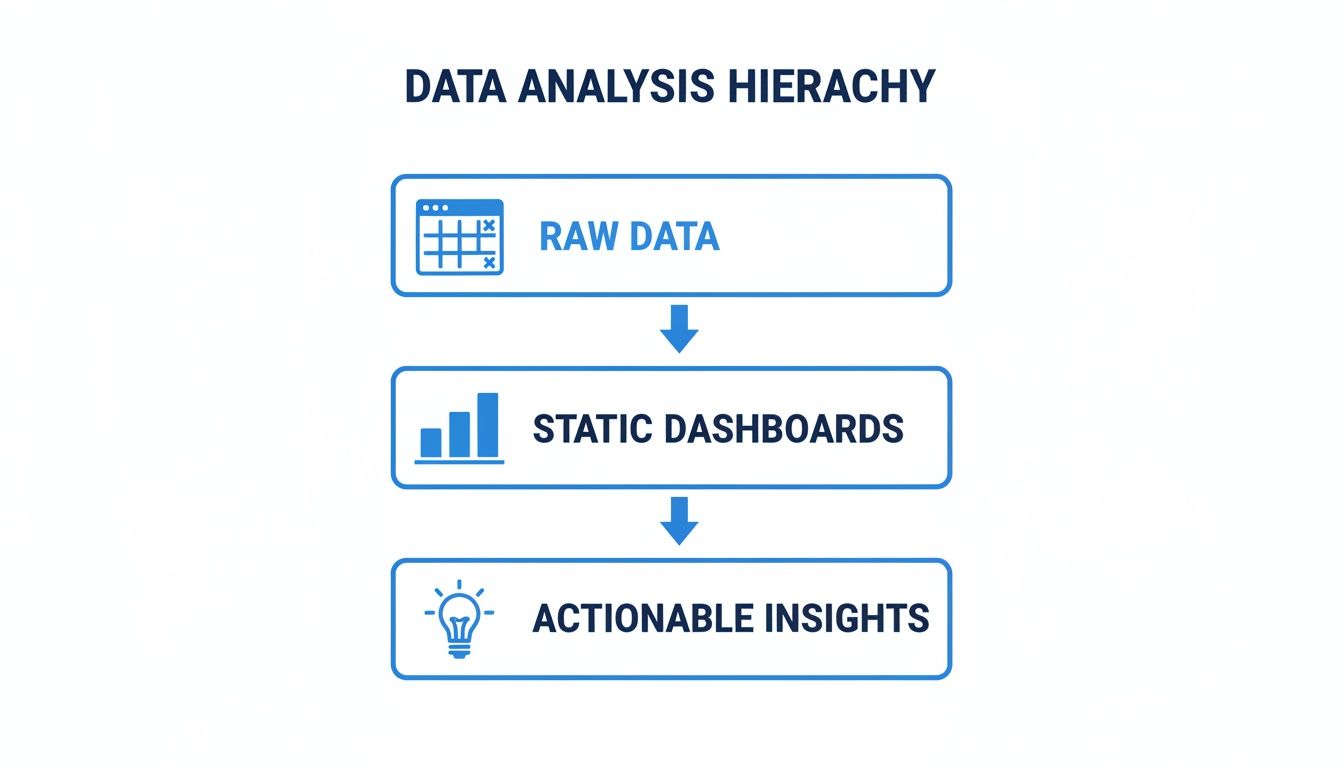
As the diagram shows, the goal isn’t just to see data in charts. It’s about pulling out actionable insights that actually drive decisions and move the needle.
To help you navigate the options, let’s break down the four main types of data analysis software. Each answers a different kind of business question, taking you further along the path from looking at the past to shaping the future.
Comparing Data Analysis Software Types
| Software Type | Primary Function | Business Question Answered | E-commerce Example |
|---|---|---|---|
| Descriptive | Summarises past data | ”What happened?” | A Shopify dashboard showing last month’s total revenue and top-selling products. |
| Diagnostic | Investigates the cause of an outcome | ”Why did it happen?” | A tool that correlates a sudden drop in conversion rate with a recent website update. |
| Predictive | Forecasts future outcomes | ”What is likely to happen next?” | Software that identifies customers who are at high risk of churning in the next 90 days. |
| Prescriptive | Recommends actions | ”What should we do about it?” | An AI platform suggesting the optimal discount to offer a specific customer segment to prevent churn. |
Understanding these distinctions is key. You can’t fix a problem you don’t understand, and you can’t plan for the future if you’re only ever looking backwards. Let’s dig into each one.
Descriptive Analytics: The Rearview Mirror
The most common type of data analysis software focuses on Descriptive Analytics. Think of these tools as your business’s rearview mirror—they are brilliant at summarising past events to tell you exactly what has already happened.
Your standard Shopify or Google Analytics dashboard is a perfect example. They give you a clean, simple summary of historical data, answering questions like:
- How much revenue did we generate last month?
- Which marketing channels brought in the most traffic?
- What were our top-selling products during the Black Friday sale?
These platforms are essential for basic reporting and keeping an eye on your key performance indicators (KPIs). When you’re looking for these kinds of solutions, exploring the best marketing dashboard software can help you see what’s out there. But they have a limit: they show you the numbers, but they don’t explain the why behind them.
Diagnostic Analytics: The Why Behind The What
When you need to get to the root cause of an event, you turn to Diagnostic Analytics. If descriptive tools tell you the engine warning light is on, diagnostic tools are the mechanic who plugs in a computer to find out why.
This software goes a layer deeper. It connects different data points to uncover relationships and dependencies, helping you answer much more specific questions:
- Why did our conversion rate drop by 15% last week?
- Did that new ad campaign on Meta actually cause the spike in sales for our new product line?
- Is there a link between the recent website update and the increase in abandoned carts?
Diagnostic analysis is the bridge between seeing a problem and truly understanding it. It shifts the focus from simple reporting to active investigation, giving your team the power to find and fix the root causes of performance changes.
Predictive Analytics: Forecasting The Future
Predictive Analytics acts as your business’s weather forecast. It uses historical data, clever statistical algorithms, and machine learning to figure out the likelihood of future outcomes. This software doesn’t just look back; it helps you prepare for what’s just around the corner.
This category of software helps businesses shift from being reactive to proactive. For an e-commerce brand, predictive tools are all about answering forward-looking questions:
- Which of my customers are most likely to churn in the next 90 days?
- What’s our projected revenue for the next financial quarter?
- How much inventory should we order to meet the demand we expect for the summer season?
Prescriptive Analytics: Recommending The Best Path
Finally, Prescriptive Analytics represents the most advanced frontier. These tools don’t just predict what might happen; they recommend specific actions you should take to get the outcome you want or avoid a potential problem. Think of it as a GPS that not only forecasts traffic but also suggests the best alternative route in real-time.
Powered by sophisticated AI, this software analyses potential decisions and their likely impacts, offering clear, direct guidance. It answers the ultimate strategic question: “What should we do now?”
For instance, it might recommend shifting ad spend between channels to maximise your return, or suggest specific discounts for customer segments at a high risk of churning. It’s about turning insight directly into action.
Essential Features for E-Commerce Data Analysis
Choosing the right data analysis software feels a lot like hiring a new team member. You’re not just looking for a tool that crunches numbers; you need a partner that understands the unique pulse of your e-commerce business. The market is flooded with options, but a handful of core features separate the merely functional from the truly game-changing.

Let’s cut through the marketing noise and get straight to the non-negotiables—the capabilities that turn a data platform into your most valuable analyst.
Seamless and Comprehensive Integrations
Your e-commerce business isn’t run on a single app. It’s an ecosystem of specialised tools, each generating a crucial piece of the puzzle. A powerful analysis platform has to connect to this entire stack, effortlessly.
This goes way beyond just plugging into Shopify or Google Analytics. The real value comes from unifying data from every corner of your operations.
- E-commerce Platforms: Direct links to Shopify, Magento, or BigCommerce are table stakes. This is the bare minimum.
- Advertising Channels: It must pull clean data from Google Ads, Meta Ads, and TikTok to give you an honest read on your return on ad spend (ROAS).
- Marketing and CRM: Integrations with tools like Klaviyo or HubSpot are vital for connecting the dots between your marketing efforts and customer lifetime value (CLV).
- Inventory and Operations: Connecting to your inventory management system is how you prevent those painful stockouts or costly overstock situations.
Without these deep, pre-built integrations, your team is right back where they started: manually exporting spreadsheets. That’s the very problem you’re trying to solve.
Proactive Monitoring and Automated Alerts
The most valuable insights are often the ones you weren’t looking for. A great data analysis tool shouldn’t just sit there waiting for you to ask the right questions. It needs to act as a vigilant watchdog, constantly scanning your key metrics for any significant shifts.
This is a game-changer for busy teams. Imagine getting an email alert the moment your ad spend on a campaign starts delivering diminishing returns. Or a notification that a bestseller is at risk of stocking out based on its current sales velocity. This proactive capability turns your software from a passive reporting tool into an active analyst, helping you get ahead of problems before they hit your bottom line. You can learn more about how dashboards can support this in our guide to creating an effective business intelligence dashboard.
Natural Language Query and Interaction
The days of needing a data scientist to build complex queries are over. Modern software should empower everyone on your team—from the founder to a marketing intern—to get answers from your data simply by asking questions in plain English.
This capability, known as a Natural Language Query (NLQ) interface, truly democratises data access. It means you can ask, “Which marketing channel had the best ROI last month?” or “Compare conversion rates for new versus returning customers in Q2” and get an immediate, clear answer.
This removes the technical wall between your team and your data. It fosters a culture where data-driven decisions become the norm, not the exception, and it eliminates the bottleneck of relying on a single “data person” for every little question.
Automated Root Cause Analysis
Spotting a problem is only half the battle. A dashboard might show you that your conversion rate dropped by 10%, but it won’t tell you why. Was it a broken discount code? A slow-loading page? A poorly performing ad?
This is where automated root cause analysis becomes essential. Instead of just flagging an issue, the software should automatically dig through your connected data sources to pinpoint the most likely cause. It might correlate the conversion drop with a recent website deployment or link it to a specific traffic source that suddenly started underperforming. This feature delivers answers, not just more data points, saving your team hours of frustrating detective work.
Finally, any software for analyzing data must come with enterprise-grade security. You’re connecting your company’s most sensitive information, after all. Look for platforms that offer end-to-end encryption and comply with standards like SOC 2 and GDPR to ensure your data stays protected.
How AI Gives Everyone an Analyst on Their Team
For a long time, serious data analysis was locked away in a room with data scientists. Founders, marketers, and operators had to put in a request and wait. AI is changing that, putting the power of analysis directly into the hands of the people running the business day-to-day.
Imagine hiring a junior analyst who works around the clock. They never sleep. They have perfect, instant recall of every single transaction, ad click, and customer interaction your business has ever had. That’s what modern AI platforms bring to the table.
They do the tedious, soul-crushing work behind the scenes—cleaning data, connecting different sources, and making sense of it all. This gets your team out of spreadsheet hell and frees them up to think about what the data actually means.

This isn’t just about convenience; it’s a fundamental shift. Instead of spending hours hunting for an insight, you can now just ask a question and get a clear, data-backed answer in seconds.
The AI Analyst Your Team Actually Needs
Traditional software for analyzing data throws a wall of charts and filters at you, leaving it up to you to connect the dots and find the story. An AI analyst works backwards. It starts with your question and delivers an answer, not just a pile of raw data.
For an e-commerce brand, here’s what that looks like in practice:
- You Ask, It Answers: Forget building a complex report. You can simply ask, “Why did our customer acquisition cost jump last week?” The AI dives into your ad platforms, website analytics, and sales data to find the most likely reason.
- It Finds What You Would Have Missed: AI algorithms can spot subtle patterns a human could never see. It might notice that a specific product bundle sells exceptionally well to customers from TikTok ads, an insight that could completely reshape your marketing budget.
- It Explains the ‘Why’: The real magic is its ability to perform automated root cause analysis. When it flags a drop in conversion rates, it doesn’t stop there. It investigates why it happened, linking it back to a specific underperforming ad campaign or maybe even a technical glitch on your site.
This kind of power is driving massive investment. In the UK, the data analytics market is forecast to explode from USD 3,588.12 million in 2024 to an eye-watering USD 52,386.8 million by 2035. That’s a compound annual growth rate of 27.6%. This isn’t just hype; it shows how urgently UK businesses are turning to AI to get an edge.
Moving from Looking Backwards to Seeing Ahead
The biggest change AI brings is the shift from being reactive to proactive. Your team stops spending all their time staring in the rearview mirror at last month’s performance and starts anticipating what’s coming next.
An AI-powered platform doesn’t just answer the questions you think to ask. It proactively monitors your business and brings critical issues to your attention before they become costly problems, acting as a true strategic partner.
Imagine getting an alert that a high-margin product is about to sell out based on its current sales velocity. Or a notification that a specific ad campaign’s return on ad spend just dipped below your target. This is the kind of intelligence that protects revenue and gives your team a huge advantage.
AI is completely changing how we understand data, especially in complex areas like optimising for AI in SEO on Amazon, where customer behaviour is everything.
This proactive approach fundamentally changes your team’s job description. They stop being data reporters and become strategists who use automated insights to drive growth. To see more on this, check out our guide on how AI is shaping business intelligence. By automating the hunt for answers, AI gives everyone the power to make smarter, faster decisions based on a complete picture of the business.
A Practical Checklist for Choosing Your Software
Picking the right data analysis software is a high-stakes decision. It’s not just about buying a tool; it’s about investing in a capability that will shape your company’s ability to compete and grow—and it needs to deliver a clear return. To make the right choice, you need a structured way to evaluate vendors that cuts through the flashy demos and gets down to the practical realities of your business.
Think of this checklist as your guide for those vendor calls. It’ll help you make sure the platform you choose actually fits your team’s skills, your existing tech stack, and your long-term goals.
Evaluate Data Connectivity and Integration
Let’s be blunt: a tool is only as good as the data it can access. Your data is scattered across multiple systems, and getting it all to talk to each other isn’t a “nice-to-have”—it’s the absolute foundation of a successful setup. Don’t let a vendor get away with vague promises of connectivity.
You need to get specific with your questions:
- Essential Tools: Does your platform connect out-of-the-box with our core stack? We’re talking Shopify, Google Ads, Meta Ads, Klaviyo, and our inventory system.
- Data Freshness: How often does the data sync from these sources? Is it hourly, daily, or something close to real-time?
- Custom Sources: What’s the process for connecting to our more unique data sources, like our internal databases or our specific third-party logistics (3PL) provider?
If a platform requires a ton of engineering effort just to get your data connected, it’s going to delay your time-to-value and drive up the total cost of ownership.
Assess Usability and Team Adoption
The most powerful software in the world is completely useless if your team finds it too complicated to use. The whole point is to empower your business users—the marketers, operators, and founders—not to create a new dependency on a single data expert.
Focus on what the user experience will be like for a non-technical person:
- Onboarding: What does the onboarding process actually look like for a marketing manager who isn’t a data analyst?
- Ease of Use: Can someone on my team get an answer to a business question like, “Which products have the highest return rate?” without writing code or wrestling with a complex report builder?
- Training: What level of training and ongoing support do you provide to make sure our team can actually use the software effectively?
Scrutinise Scalability and Security
As your business grows, your data volume and complexity will explode. The software you choose today has to be able to handle the scale you’re planning for tomorrow without grinding to a halt.
And just as important is security. You’re entrusting this platform with your most sensitive commercial information.
Security and data governance are not afterthoughts; they are critical requirements. A breach can cause irreparable damage to your brand and customer trust. Always verify a vendor’s security credentials and data handling policies before signing a contract. You can find more details in our guide on data governance best practices.
Understand the True Cost and ROI
Finally, look beyond the monthly subscription fee. The total cost of ownership (TCO) includes implementation fees, training costs, and any internal resources you’ll need to maintain the system.
This focus is clear in the UK, where business intelligence software grabs a whopping 72% revenue share of the market. This dominance shows that UK leaders are prioritising robust software that provides sharp analysis without needing complex, service-heavy projects to get it running. You can read more about the UK’s business intelligence market trends for more on that.
Ask direct questions about the money:
- Pricing Model: Is your pricing based on users, data volume, or the number of connectors? What are the potential hidden costs we should know about?
- Implementation: Are there any one-off setup fees or professional services costs?
- Return on Investment: Can you show us case studies of how other e-commerce brands have achieved a positive ROI with your platform?
By methodically working through this checklist, you can confidently select the right software for analyzing data—one that will become a trusted partner in driving smarter, faster growth.
What’s Your Next Move?
The real goal here is to stop chasing data and start having insights come to you.
If there’s one thing we’ve established, it’s that for any ambitious e-commerce brand, the right data-analysis software isn’t a nice-to-have. It’s the engine that saves you time, stops you from making expensive mistakes, and fuels real, sustainable growth.
So, what’s your next step? Pinpoint the single biggest data headache that’s holding your business back right now.
Is it the nagging feeling that you don’t truly know your marketing ROI across all your different channels? Maybe it’s the constant tug-of-war with inventory, where you’re either selling out too fast or sitting on piles of cash in a warehouse. Or perhaps it’s the struggle to really get a grip on customer lifetime value, making your retention strategy feel like guesswork.
Nail Down Your Core Problem
Once you name that primary bottleneck, the path to the right solution gets a whole lot clearer. Don’t fall into the trap of trying to solve every data problem at once. That’s a recipe for analysis paralysis. Instead, find the one that, if solved, would make the biggest immediate difference to your bottom line.
Think of that problem as your compass. It will guide your search and keep you from getting distracted by shiny objects.
The most effective way forward is to shift from a vague wish for “better data” to a concrete mission. For example: “We need to cut our customer acquisition cost by 15% by figuring out which ad campaigns are actually profitable.” That kind of clarity turns a fuzzy software search into a focused, targeted evaluation.
This is exactly where modern AI analyst platforms like Menza come in. They’re built to tackle these specific, high-stakes challenges. They plug into all your scattered data sources—from Shopify and Google Ads to your inventory system—and forge them into a single, reliable source of truth.
This is what lets your team finally break free from wrestling with clunky spreadsheets and reports that are out of date the moment you build them. By asking simple questions in plain English, you get instant, data-backed answers.
The result? You build an organisation that makes smarter, faster decisions. You move from hunches to confidence, unlocking the next stage of your growth.
Got Questions? We’ve Got Answers
Stepping into the world of data analysis software can feel a bit like learning a new language. You know it’s important, but the details can be tricky. This is the spot where we tackle the most common questions we hear from e-commerce founders and marketing teams, giving you the straight answers you need to choose with confidence.
How Long Does It Take to Set Up This Kind of Software?
The setup time can be wildly different, and it’s one of the biggest distinctions between old-school tools and modern ones.
Traditional business intelligence (BI) platforms can be a real project. We’re talking months of configuration, often needing a dedicated tech person to wrangle data sources and painstakingly build dashboards. It can be a long, drawn-out affair before you see any actual value.
Modern, AI-first solutions, on the other hand, are built for speed. They come with pre-built connectors for hundreds of tools you already use, like Shopify and Google Ads. This means you can often connect your key data sources and start pulling genuine insights within hours or days, not months. The whole point of this new generation of software is to get the technical headaches out of the way so you can get a return on your investment as fast as humanly possible.
Is My Company Data Secure in the Cloud?
This is a big one, and it should be. Any vendor worth their salt puts security at the very top of their list. When you’re looking at different platforms, you need to see robust security measures as a non-negotiable standard. Look for things like end-to-end encryption, which protects your data both when it’s flying across the internet and when it’s just sitting on a server.
Before you sign anything, do your homework on the vendor’s security and compliance. Look for certifications like SOC 2 or proof of GDPR compliance, which show they meet tough industry standards. It’s also critical to get confirmation that you, and only you, retain full ownership and control over all of your raw data.
Do I Need to Hire a Data Analyst to Use This?
Not anymore. And honestly, this is probably one of the biggest game-changers.
The old BI tools absolutely required a specialist. You needed someone who could write queries, build reports from scratch, and then translate the findings for the rest of the team. The new wave of AI-powered software was built specifically to eliminate that bottleneck.
The magic is in the natural language interface. It lets anyone on your team—from the founder to a marketing coordinator—ask complex questions in plain English. You just type what you want to know and get a clear, data-backed answer in seconds. In effect, the software becomes your team’s dedicated AI data analyst, making powerful insights accessible to everyone, not just the tech experts.
Ready to stop wrestling with spreadsheets and start getting clear, automated answers? See how Menza can act as your always-on AI analyst, delivering proactive insights that drive smarter business decisions. Get started with Menza today.
Stop guessing. Start knowing.
Menza connects to your Shopify, Klaviyo, ad platforms, and 650+ other connections. Ask questions in plain English and get answers you can trust — no spreadsheets, no code, no waiting.