A Modern Playbook to Reduce Customer Acquisition Cost
To bring down your customer acquisition cost, you have to look beyond tweaking individual ad channels. The only way to make a real dent is with a data-driven, full-funnel approach. This means tracking the entire journey, from the first ad someone clicks to their tenth purchase, so you can spot exactly where your budget is being wasted. Real cost reduction comes from understanding how marketing, sales, and retention actually work together.
Why Your Customer Acquisition Costs Are Spiralling
If your customer acquisition cost (CAC) feels like a runaway train, you’re not alone. Countless e-commerce brands are watching their marketing budgets evaporate with less and less to show for it. The old playbook of just pumping more money into Meta or Google Ads is officially broken. The reasons are a complex mix, creating a brutal environment for any brand trying to grow.
This perfect storm is hitting UK businesses particularly hard. Right now, in 2025, customer acquisition costs have shot to all-time highs. Brands are paying up to 222% more for each new customer than they did back in 2013. For many stores on Shopify, that works out to a painful £68-£78 per acquisition.
This surge is fed by a nasty combination of economic stagnation—with the UK economy expected to grow by a sluggish 0.3%—and consumer spending inching up by a mere 1.3%. You can get a deeper look into these figures on UK e-commerce CAC trends on wearefounders.uk.
UK E-commerce CAC Benchmarks by Industry
To put this in perspective, here’s a quick look at the average Customer Acquisition Costs across different D2C sectors in the UK. The numbers highlight just how much financial pressure brands are under to make every marketing pound count.
| Industry Sector | Average CAC (£) |
|---|---|
| Fashion & Apparel | £65 - £95 |
| Health & Wellness | £70 - £110 |
| Home Goods | £85 - £130 |
| Food & Beverage | £45 - £80 |
| Beauty & Cosmetics | £55 - £100 |
These figures aren’t just abstract numbers; they represent the real cost of getting a new customer through the door. When your CAC is this high, your margin for error is practically zero.
The Root Causes of Rising CAC
So, what’s actually driving these costs up? A few key factors are squeezing marketers from all sides, making efficient growth harder than ever. Getting a handle on these pressures is the first step toward building an acquisition strategy that can actually withstand them.
- Intensified Competition: It’s never been easier to launch an e-commerce store. That’s great for entrepreneurs but terrible for ad costs, as it floods every niche with competitors all bidding on the same keywords and chasing the same audiences.
- Ad Platform Saturation: The big platforms like Meta and Google are crowded, creating an auction environment that constantly drives ad prices higher. Simply reaching your ideal customer costs a lot more than it did just a few years ago.
- Economic Headwinds: With household budgets getting tighter, people are thinking twice before buying. They take longer to decide, which means you need more marketing touchpoints to get them across the line, pushing up the cost of a single sale.
The core problem isn’t just that ad spend is rising; it’s the lack of a single, clear picture. When your Shopify data, ad platform metrics, and analytics all live in different places, it’s impossible to see what’s really going on and make smart, cost-saving decisions.
Adopting a Full-Funnel Mindset
The only sustainable way to cut your acquisition cost is to stop guessing and start analysing. A full-funnel approach means you connect the dots between every single stage of the customer journey.
You need real answers to the big questions: “Which channels are bringing in customers with the highest lifetime value?” or “Where are the biggest drop-off points in my checkout process?” This is where modern analytics tools become non-negotiable.
Instead of drowning in a dozen different dashboards, a platform like Menza cuts through the noise. It analyses all your data sources together and gives you clear, plain-English answers. This guide will walk you through a practical playbook to audit your data, optimise your entire funnel, and finally get your acquisition costs under control.
Conducting a Ruthless Funnel and Data Audit
Before you can fix your customer acquisition cost, you have to play detective. Your mission is to find all the hidden leaks in your funnel where you’re bleeding money, time, and potential customers. This isn’t about glancing at a few dashboards. It’s about a ruthless, top-to-bottom audit of your entire customer journey, from the first ad impression right through to the final thank-you page.
A classic mistake is looking at data in silos. Your Meta Ads dashboard tells one story, Google Analytics tells another, and your Shopify backend tells a third. When these platforms aren’t talking to each other, you’re left with a fragmented picture. It’s impossible to find the real source of the problem or truly understand how much it costs to win a new customer.
The goal here is to create a single source of truth. By connecting these disparate data sources, you can finally start asking the questions that actually matter and get answers you can trust.
Mapping the Entire Customer Journey
To find the leaks, you need a map. Start by sketching out every single touchpoint a potential customer has with your brand. Think visually. Trace their path from the moment they see an ad to the moment they complete a purchase.
This map helps you identify the key conversion stages and, more importantly, the drop-off points. You need to know your numbers at each step to see where the biggest opportunities for improvement are hiding.
- Awareness: How many people are seeing your ads or organic content? What’s your click-through rate (CTR)?
- Consideration: Once they land on your site, how many visit a product page? What’s the bounce rate?
- Conversion: What percentage of visitors add an item to their cart? And critically, how many of those actually complete the checkout?
- Retention: What’s the repeat purchase rate for customers acquired from different channels?
The most expensive mistake is paying to acquire a customer only to lose them to a confusing website or a clunky checkout. Pinpointing these friction points is the fastest way to improve your marketing ROI.
Asking the Right Questions
Once you have a unified view of your data, you can move beyond surface-level metrics. A tool like Menza lets you ask specific, conversational questions and get immediate, data-backed answers—no technical expertise required.
Instead of just staring at your overall CAC, you need to dig deeper. For a more detailed breakdown, check out our guide on how to measure marketing ROI effectively.
Here are some of the critical questions you should be asking your data to uncover wastage:
- “What’s our conversion rate from add-to-cart to purchase on mobile versus desktop?”
- “Which marketing channel had the highest blended CAC over the last 30 days?”
- “Show me the customer journey for users who abandoned their cart after entering a discount code.”
- “What is the 60-day LTV of customers we acquired from our latest TikTok campaign compared to our Google Ads campaign?”
This common cycle of high ad spend and intense competition is what leads to stagnating acquisition costs.
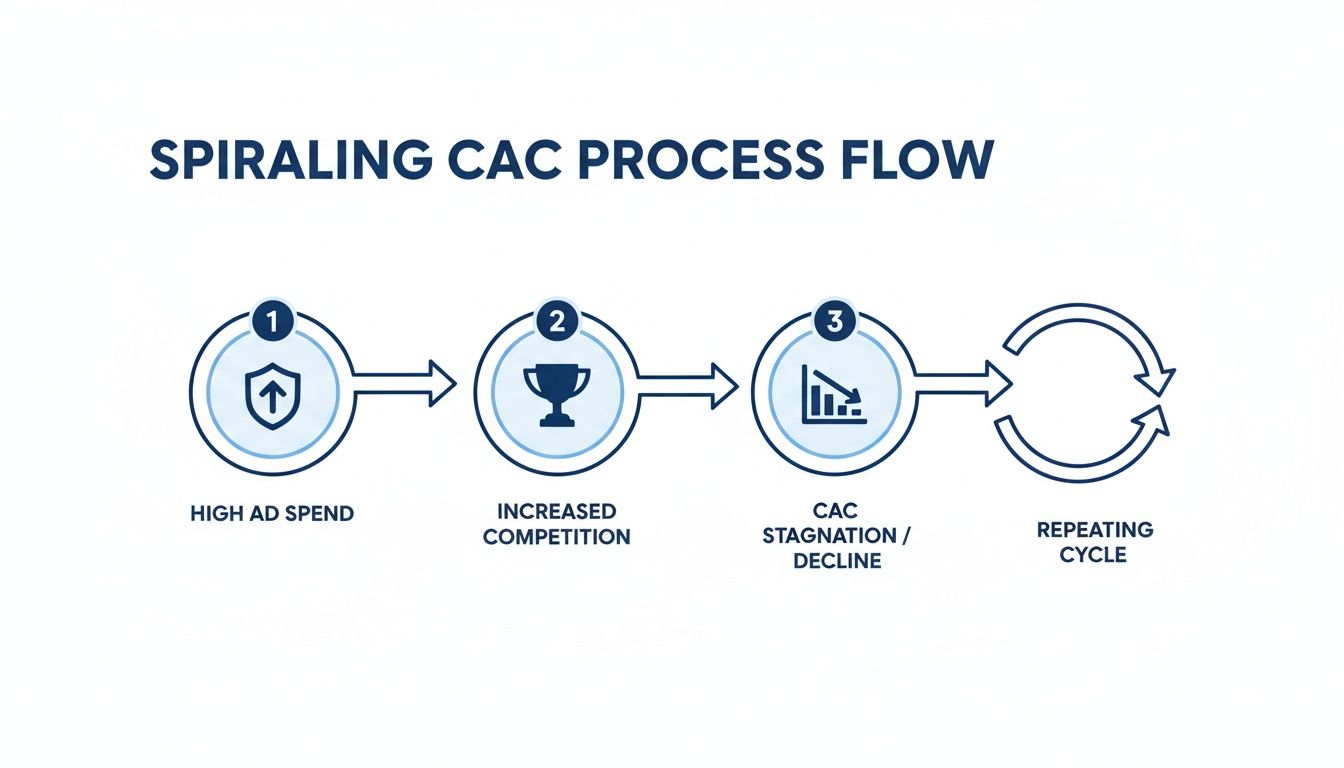
This visual really hammers home how simply throwing more budget at ads without fixing underlying funnel issues rarely leads to sustainable growth. In fact, it can quickly inflate your CAC.
From Insights to Action
An audit is only useful if it leads to action. Your findings should give you a clear, prioritised hit list of areas to fix. For example, if your audit reveals a massive drop-off between adding an item to the cart and starting the checkout, that’s your next focus.
Is it a surprise shipping cost? Is the page loading too slowly on mobile? By identifying the exact problem, you can focus your resources on a solution that will have a direct impact. This data-first approach transforms your efforts from scattered guesswork into a targeted strategy designed to efficiently lower your customer acquisition cost.
Refining Your Targeting and Supercharging Ad Creatives
Once you’ve audited your funnel and know where the leaks are, the real work begins. It’s time to stop pouring money into ads that just aren’t pulling their weight. Spraying your budget across broad, generic audiences is one of the fastest ways I’ve seen brands burn through cash and inflate their acquisition costs.
The fix is a two-pronged attack: sharpening your audience targeting to a razor’s edge and systematically levelling up your ad creatives. This is about moving from guesswork to data. Who is your ideal customer, really? Not who you think they are. Answering that question with hard numbers is the bedrock of any strategy to reduce customer acquisition cost.
Pinpoint Your Most Profitable Customer Segments
The most powerful insights you have are already sitting in your customer base. Stop relying on the generic personas ad platforms give you and start digging into the demographics, behaviours, and purchase histories of your highest-value customers. These are the people who buy again and again—the ones with the highest lifetime value (LTV).
With a tool like Menza, you can uncover these segments just by asking plain-English questions. For example, a simple query like, “What are the common attributes of customers with an LTV over £500?” might instantly show you that your best buyers are in a specific age bracket, live in certain postcodes, and almost always purchase a particular product bundle.
Armed with that knowledge, you can build lookalike audiences on platforms like Meta with incredible precision. You’re no longer guessing; you’re telling the algorithm to find more people who look exactly like your proven, most profitable customers. This alone can dramatically improve your chances of a lower-cost conversion.
Exclude Underperforming Audiences Ruthlessly
Just as critical as knowing who to target is knowing who not to target. Your audit probably flagged a few audience segments that love to click but never seem to convert. Or maybe they make one small purchase and then disappear forever. These are budget drains.
You need to constantly monitor the performance of different audience groups and be absolutely ruthless about excluding the ones that don’t perform. This might be certain age groups, locations, or interests that consistently deliver a high cost-per-acquisition without a corresponding high LTV. Systematically cutting these segments from your campaigns is one of the most direct ways to make every pound you spend work harder.
By focusing your budget on proven, high-performing segments and actively excluding the unprofitable ones, you shift from a scattergun approach to precision targeting. This simple change can have a massive impact on your overall CAC.
Implement a Structured Creative Testing Framework
Even with perfect targeting, a weak creative will fall flat. Your ad is your frontline soldier, and it needs to be effective. To supercharge your creative, you have to move away from random A/B tests and adopt a structured framework that produces consistent winners.
Start by breaking your ads down into their core components and testing each one methodically. This is how you learn what actually resonates with your audience, element by element.
- The Hook: Test the first 1-3 seconds of your video or the main headline of an image ad. Does an outrageous claim grab more attention than a relatable problem?
- The Angle: A single product can be sold from dozens of angles. For a skincare brand, you could test a “scientific ingredients” angle against a “confidence-boosting results” angle.
- The Offer: Don’t just stick to one incentive. See how a “20% Off” discount performs against a “Free Shipping” offer or a “Buy One, Get One Free” deal.
- The Call-to-Action (CTA): Test direct commands like “Shop Now” against softer, lower-commitment CTAs like “Learn More” to see which one drives the most qualified traffic.
When you’re working on ad creative, learning how to craft compelling video hooks is a non-negotiable skill. That initial engagement is often what separates a winning ad from a dud. For a deeper look at applying these principles across your campaigns, check out our guide on how to build a full-funnel advertising strategy.
Just how critical is this efficiency? Look at the UK e-commerce market. By 2025, benchmarks show massive differences between industries—electronics brands are paying £377 per customer, while arts and entertainment get by on a leaner £21. The alarming part is that all sectors have seen acquisition costs jump by as much as 222% since 2013, as ad inflation and minimal 0.3% GDP growth squeeze everyone’s margins.
The final piece of this puzzle is proactive monitoring. Don’t wait for your weekly report to find out your best-performing ad started fatiguing three days ago. An automated system like Menza can alert you the moment an ad’s performance dips below your threshold. This lets you swap in fresh creative before you’ve wasted any significant budget, turning creative management from a reactive chore into a strategic advantage.
Optimising Your Landing Pages and Checkout Flow
Even the most brilliant ads will fall flat if they lead to a frustrating website experience. You’ve already paid to get visitors to your site; now, the goal is to make it as easy as possible for them to convert. This is where optimising your landing pages and streamlining your checkout becomes a powerful lever to reduce customer acquisition cost.
Improving your conversion rate means every pound spent on ads goes further. A small lift here can have a massive impact on your bottom line without you needing to spend a single extra penny on advertising. It’s about maximising the value of the traffic you already have.
The journey from an ad click to a conversion is fragile. Any friction, confusion, or unexpected surprises can cause a potential customer to bail. That’s why a methodical approach to on-site optimisation is non-negotiable for sustainable growth.
A/B Testing Your Critical Landing Page Elements
Your landing page is your digital salesperson. Its one job is to convince the visitor to take the next step. Instead of making changes based on gut feelings, a structured A/B testing plan lets the data guide your decisions.
Start by focusing on the elements with the biggest potential impact on a visitor’s decision-making process.
- Headlines: Does your headline match the promise made in the ad? Test a benefit-driven headline (e.g., “Get a Flawless Glow in 5 Minutes”) against a feature-focused one (e.g., “Our Vitamin C Serum with Hyaluronic Acid”).
- Calls-to-Action (CTAs): The smallest changes here can yield big results. Test the button colour, text (“Add to Basket” vs. “Buy It Now”), and placement to see what drives the most clicks.
- Social Proof: How you display customer trust matters. Test video testimonials against star ratings or user-generated photos to see which format resonates most with your audience.
A common mistake is testing too many variables at once. To get clean, actionable data, isolate a single element—like the headline—and test two distinct versions against each other. This ensures you know exactly what caused the change in performance.
Removing Friction from Your Checkout Process
The checkout is the final hurdle, and it’s where an astonishing number of sales are lost. The average cart abandonment rate hovers around 70%. Think about that: seven out of ten potential customers who add items to their cart leave without buying. Every percentage point you can shave off that number directly lowers your effective CAC.
Your primary goal should be making the checkout as seamless and transparent as possible.
Common Checkout Conversion Killers
| Friction Point | The Problem | The Solution |
|---|---|---|
| Forced Account Creation | Customers hate being forced to create an account before they can buy. | Offer a prominent guest checkout option. |
| Surprise Shipping Costs | Unexpected fees are the number one reason for cart abandonment. | Display shipping costs upfront on the product or cart page. |
| Limited Payment Options | Not offering popular methods like PayPal or Apple Pay can deter users. | Integrate a variety of trusted payment gateways. |
| Complex Forms | Asking for unnecessary information adds steps and frustration. | Only ask for the essential details needed to fulfil the order. |
To find your specific friction points, you need to dig into your data. A platform like Menza allows you to ask direct questions, like, “What is our checkout abandonment rate by device?” If you discover mobile abandonment is significantly higher, that points to a specific problem with your mobile checkout experience that needs immediate attention.
Proactive Monitoring to Catch Costly Glitches
Technical issues can silently sabotage your conversion rates. A broken “Add to Cart” button or a malfunctioning payment gateway can go unnoticed for hours—or even days—wasting thousands in ad spend.
This is where proactive monitoring becomes your safety net. Instead of manually checking your site, you can use an automated system to keep watch for you. For instance, you could set up an alert in Menza to notify you instantly if your site-wide conversion rate suddenly drops by more than 10% in an hour.
This allows your team to react immediately, find the glitch, and fix it before it becomes an expensive disaster. This automated oversight transforms your approach from reactive problem-solving to proactive performance management, ensuring your optimised funnel stays that way.
Boosting Retention to Increase Customer Lifetime Value
The relentless chase for new customers often blinds brands to a far more powerful strategy for managing acquisition costs: making every customer you already have more valuable. Shifting your focus from pure acquisition to robust retention isn’t just a defensive move; it’s the ultimate offensive play in a competitive market.
A high Customer Lifetime Value (LTV) gives your business the financial firepower to absorb higher acquisition costs and sustainably outspend rivals. When you know a customer is likely to spend more with you over time, you can justify a larger upfront investment to win their business. This fundamentally changes the economics of your marketing.

Nail the Post-Purchase Experience
The customer journey doesn’t end at checkout; that’s where the real relationship begins. A stellar post-purchase experience is what turns a one-time buyer into a loyal advocate. It’s your first and best chance to prove you value their business beyond the transaction.
A simple, effective onboarding sequence can make all the difference. For a skincare brand, this could be a series of emails with tips on how to use their new products. For a tech gadget, it might be a quick video guide to a key feature. The goal is simple: ensure the customer gets immediate value from what they bought.
Build Loyalty That Actually Lasts
Once a customer has had a great first experience, you need to give them compelling reasons to come back. Loyalty programmes, when done right, are incredibly effective. They create a virtuous cycle where customers feel rewarded for their repeat business, which encourages even more.
Consider these approaches to foster genuine loyalty:
- Tiered Rewards: Create a system where customers unlock better perks—like exclusive discounts or early access to new products—as they spend more. This gamifies the experience and provides a clear incentive to stick around.
- Exclusive Community Access: Offer your best customers a spot in a private group or forum. This builds a sense of belonging and transforms customers into a community that can provide priceless feedback.
- Surprise and Delight: Every so often, send a small, unexpected gift or a personalised discount to a loyal customer. These gestures can generate powerful word-of-mouth and strengthen their emotional connection to your brand.
For UK D2C brands, this focus on retention is more critical than ever. In 2025, acquiring a new customer costs 5-25 times more than keeping an existing one, with the average e-commerce CAC climbing to £70. Top-performing brands combat this by obsessing over service, knowing that loyal customers have repurchase rates of 60-70%, compared to just 20% for newcomers.
Impact of Retention on Profitability
The data consistently shows that even a tiny improvement in retention can have an outsized effect on your bottom line. It’s one of the highest-leverage activities a brand can focus on.
| Retention Rate Increase | Average Impact on Profitability |
|---|---|
| 5% | 25% - 95% |
| 10% | 50% - 150%+ |
These figures, often cited in studies by firms like Bain & Company, highlight why the most resilient brands are retention-obsessed. The investment pays for itself many times over.
You can explore more of these e-commerce benchmarks on LoyaltyLion.
Proactive Service and Spotting Churn Risk
This is where operational insights become a game-changer. Imagine getting an automated alert from a platform like Menza that one of your bestselling products is at risk of a stockout. This lets you act proactively—perhaps by notifying customers of a brief delay or suggesting a similar item—and prevent a poor experience that could lead to churn.
The most powerful way to boost LTV is by identifying at-risk customers before they leave. By analysing purchase frequency and engagement data, you can spot customers who are showing signs of drifting away and launch targeted re-engagement campaigns to win them back.
These campaigns don’t have to be complicated. It could be a simple “We miss you” email with a special offer or a survey asking for feedback. The key is to show them you’ve noticed they’re gone and that you value their business. For a more in-depth look at this crucial metric, check out our guide on how to calculate customer lifetime value.
By making retention a core part of your growth engine, you build a more resilient, profitable business that can weather the rising tide of acquisition costs.
Answering Your Top Questions About CAC
As teams start getting serious about managing their ad spend, a few common questions always pop up. It’s natural when you’re shifting to a more data-driven approach. Think of this as your practical FAQ for moving forward—getting these answers right helps make sure the core concepts we’ve discussed really stick.
Let’s tackle the most frequent ones I hear from brands trying to reduce customer acquisition cost.
What Is a Good Customer Acquisition Cost for a UK E-commerce Brand?
This is the million-pound question, isn’t it? The honest answer is: there’s no single number. A “good” CAC is completely relative to your industry, Average Order Value (AOV), and most importantly, your Customer Lifetime Value (LTV).
What’s perfectly sustainable for one brand could be a total disaster for another.
The gold standard metric you should be obsessing over is the LTV to CAC ratio. A healthy, sustainable business typically aims for a ratio of at least 3:1. In simple terms, for every pound you spend to get a customer, they should generate at least three pounds in revenue over their lifetime with your brand.
For example, if your average customer spends £300 over their lifetime, then a CAC of £100 or less is a solid target. Remember, UK benchmarks vary wildly—fashion might average around £129 while electronics can hit £377. The key isn’t to chase some arbitrary industry number, but to relentlessly improve your own LTV:CAC ratio using the strategies in this guide.
How Can I Calculate CAC Accurately Without Complex Spreadsheets?
This is a massive pain point for so many brands, usually because their data is all over the place. The basic formula—Total Marketing & Sales Spend ÷ Number of New Customers Acquired—looks simple on paper but gets messy fast. Your “total spend” is often fragmented across Google Ads, Meta, SEO agencies, influencer payments, and who knows what else.
Manually pulling that from a dozen sources and wrestling with spreadsheets is where things break down. This is where modern analytics tools become indispensable.
Instead of all that manual work, a platform can connect directly to all your data streams. It automatically adds up every relevant cost and correctly attributes new customers. For a clear breakdown of how to think about this, check out this guide on calculating the cost of customer acquisition.
With an integrated system, you eliminate the manual data wrangling and human error that plague spreadsheet-based analysis. You get a single, trustworthy figure for your blended CAC, updated in real time.
This simple shift means you can spend your time acting on the numbers, not just trying to find them.
How Can a Small Non-Technical Team Implement These Strategies?
This is one of the most common and valid concerns I hear. Most growing businesses don’t have a dedicated data analyst, and the idea of implementing a complex data strategy feels completely overwhelming.
The solution is to find tools built specifically for non-technical users. The old way required knowing SQL or how to build complicated dashboards from scratch. Modern platforms, however, are often built around a plain-English, conversational interface. You can ask questions just like you would a human analyst.
Even better, proactive monitoring features mean you don’t even have to know what to look for.
- Automated Anomaly Detection: The system automatically scans your data for unusual patterns.
- Proactive Alerts: It flags when something important happens, like a sudden drop in conversions.
- Plain-English Insights: It explains what the data means, so you know exactly what action to take next.
This automates all the heavy lifting of analysis. Your team doesn’t need to be data experts to get expert-level insights. The system finds the problems, and your team can focus all their energy on solving them and executing a smarter growth strategy.
Ready to stop guessing and start getting clear, data-backed answers to your toughest business questions? Menza is the AI-powered analyst that connects to your entire data stack, monitors performance 24/7, and delivers the insights you need to reduce acquisition costs and grow profitably. Get your demo today at https://menza.ai.
Stop guessing. Start knowing.
Menza connects to your Shopify, Klaviyo, ad platforms, and 650+ other data sources. Ask questions in plain English and get answers you can trust — no spreadsheets, no code, no waiting.