
Mastering the Customer Life Cycle From First Click to Brand Loyalty
Think of the customer life cycle as the complete story of a person’s relationship with your brand. It starts the moment they first hear about you and, ideally, continues long after they’ve become a loyal, repeat buyer. It’s not about a single transaction; it’s the entire journey.
What Is the Customer Life Cycle and Why Does It Matter?
Imagine your business is a fantastic restaurant. The customer life cycle is the map showing how a passer-by goes from peeking at the menu in the window to becoming a regular who brings their friends. It’s a structured way to see and improve every single interaction they have with you.
In a crowded market, focusing only on getting new people in the door (acquisition) is a costly and short-sighted game. The real, sustainable growth comes from nurturing the entire relationship. The sharpest brands have shifted their focus from one-off sales to building long-term value. They’ve realised keeping a happy customer is far more profitable than constantly chasing new ones.
The Five Core Stages of the Journey
The customer life cycle is typically broken down into five distinct stages, each with its own goals and strategies. When you understand these phases, you can meet customers exactly where they are with the right message at the right time.
This visual shows how a prospect moves from just being aware of your brand to becoming a true advocate for it.
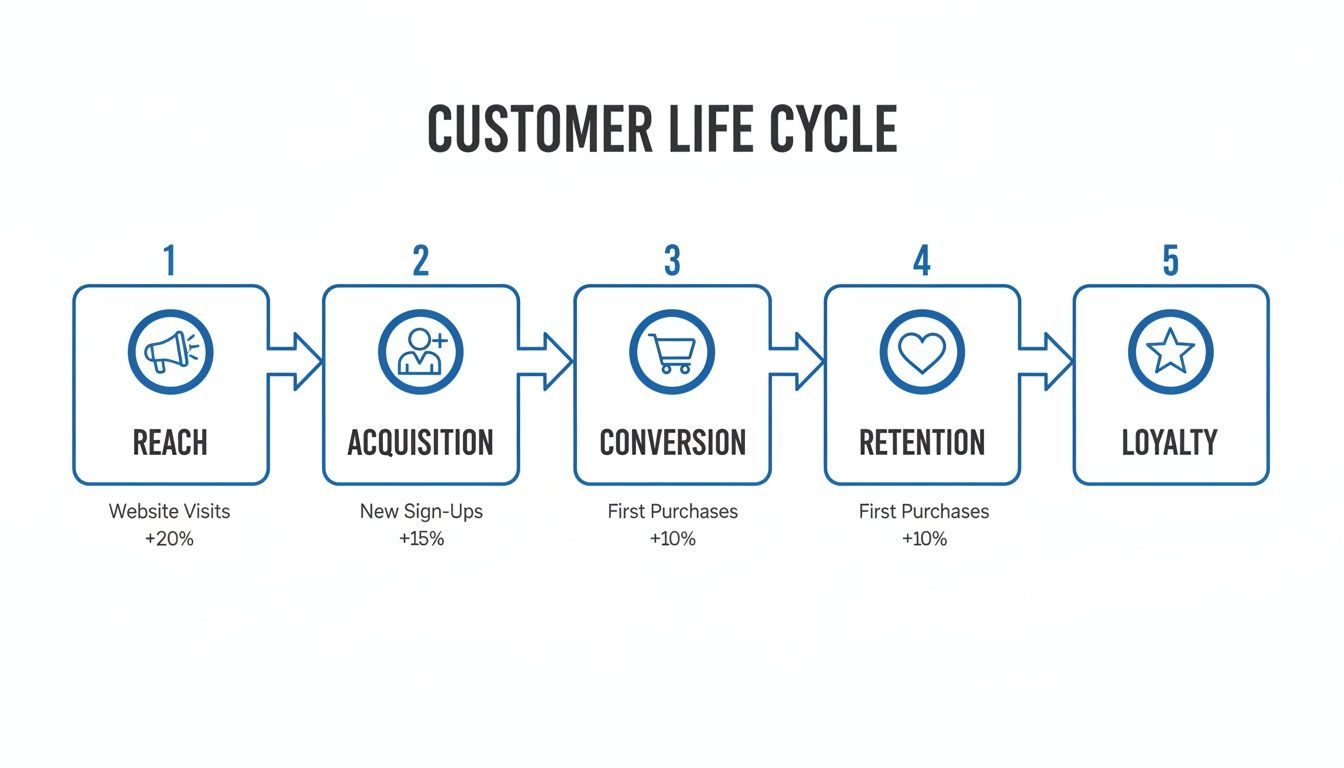
Each step builds on the last, creating a strong foundation for a profitable, long-lasting customer relationship.
By mapping your efforts across these stages, you can spot the strengths and weaknesses in your business. Are your ads great at reaching people but terrible at converting them? Do customers buy once but never come back? Looking at your business through the lens of the customer life cycle gives you the answers.
A successful business isn’t just about making a sale; it’s about starting a relationship. The life cycle model provides the framework to ensure that relationship flourishes, turning one-time buyers into lifelong advocates.
To help you get a clear picture of this journey, here’s a quick look at each stage, its main goal, and a common metric used to track how you’re doing.
The Five Stages of the Customer Life Cycle at a Glance
| Stage | Primary Goal | Key Metric Example |
|---|---|---|
| Reach | To make potential customers aware of your brand and solution. | Website Traffic / Impressions |
| Acquisition | To capture interest and turn anonymous visitors into known leads. | Newsletter Sign-ups / Lead Magnet Downloads |
| Conversion | To persuade an engaged lead to make their first purchase. | Conversion Rate / Average Order Value |
| Retention | To encourage existing customers to make repeat purchases. | Repeat Purchase Rate / Customer Lifetime Value |
| Loyalty | To transform satisfied customers into enthusiastic brand advocates. | Net Promoter Score (NPS) / Referral Rate |
Seeing your business this way—as a continuous journey rather than a series of disconnected transactions—is the first step to building a brand that lasts. Each stage presents a new opportunity to strengthen the relationship.
Making a Great First Impression with Reach and Acquisition
The first handshake matters. In the customer life cycle, the Reach and Acquisition stages are that critical first introduction, where a complete stranger becomes an interested acquaintance. This is the moment your brand steps out of the background and into a potential customer’s world, making an impression that sets the tone for the entire relationship.
Think of the Reach stage as casting a smart, targeted net. It’s not about shouting your brand’s name into the void. It’s about being present and genuinely valuable where your ideal audience is already spending their time. The goal is simple awareness—making potential customers realise you exist and might just have the solution to a problem they face.
From there, the journey flows into Acquisition. This is where awareness turns into a tangible connection. An anonymous website visitor becomes a known lead when they sign up for your newsletter, download a useful guide, or follow you on social media. You’ve captured their interest, and now a real conversation can begin.
Attracting the Right Audience in the Reach Stage
A strong customer life cycle is built on a foundation of attracting the right people from the very beginning. If you attract a mismatched audience, you’ll see it in your metrics: high bounce rates, low engagement, and wasted ad spend. Effective reach is about quality, not just quantity.
Here are a few core strategies to get this right:
- Search Engine Optimisation (SEO): Optimise your website and product pages for the exact keywords your ideal customers use. When they search for solutions, your brand should be one of the first they see. This isn’t a quick win; it’s a long-term investment in organic, high-intent traffic.
- Valuable Content Marketing: Create blog posts, videos, or social media content that educates, entertains, or solves a genuine problem for your audience. This builds trust and positions your brand as an authority long before you ever ask for a sale.
- Engaging Social Media Presence: Be active on the platforms where your target customers actually hang out. Share user-generated content, run interactive polls, and respond to comments. You’re not just broadcasting; you’re building a community.
Turning Awareness into Action During Acquisition
Once you have their attention, the next crucial step is to make a connection. The acquisition stage is where you formalise that relationship by capturing a lead’s information, which gives you a direct line of communication. A critical part of making this first impression count is learning how to reduce customer acquisition cost without sacrificing the quality of the leads you bring in.
An optimised acquisition process should feel seamless and compelling—like a natural next step for an interested user, not a hurdle they have to jump over.
The transition from an anonymous visitor to a known lead is one of the most important moments in the customer life cycle. A positive first interaction here dramatically increases the likelihood of a future purchase.
Think about it: a clunky, multi-step sign-up form can kill momentum instantly. In contrast, a well-designed, frictionless process makes a powerful statement about your brand’s commitment to a good user experience. This efficiency is vital. Just look at the UK financial sector, where digital onboarding slashed customer acquisition times. Santander cut its effort by 75%, reducing onboarding from 14 days down to just 5, while Metro Bank automated account openings to a 15-minute average. It proves that a smooth start accelerates the entire life cycle.
Ultimately, mastering Reach and Acquisition means you’re not just spending money on ads; you’re investing in the first chapter of what could be a long-term, profitable customer story. Getting this stage right doesn’t just lower your initial costs—it builds a foundation of trust that pays dividends through every stage that follows.
Turning Browsers into Buyers at the Conversion Stage
You’ve managed to get people to your site. They’re clicking around, showing interest. Now comes the moment that actually pays the bills: conversion. This is where a curious browser pulls out their wallet and becomes a paying customer. It’s more than just a transaction; it’s a critical exchange of trust where you have to deliver on every promise you’ve made so far.
This whole stage is about one thing: removing friction.
Think about a real-world shop. If the queue was long, the price tags were confusing, and they only took cash, you’d just drop your stuff and walk out. The same thing happens online, only faster. The smallest obstacle can lead to an abandoned cart—something that happens at a shocking rate of nearly 70% across e-commerce.
To win here, you have to obsessively design the path from ‘add to cart’ to ‘purchase complete’ to be as smooth and reassuring as possible. Every click, form field, and loading screen is an opportunity to either build confidence or introduce doubt.
Eliminating Friction and Building Trust
The goal is simple: make the decision to buy feel easy, safe, and smart. Your checkout process needs to be a fortress of credibility because potential customers are on high alert for red flags. This isn’t about one single fix; it’s about addressing all the common points of hesitation at once.
Here are a few tactics that flat-out work:
- Offer Flexible Payment Options: Today’s customers expect choice. It’s no longer enough to just offer credit card payments. Integrating solutions like PayPal, Apple Pay, and Buy Now, Pay Later (BNPL) services caters to different financial habits and can seriously cut down on checkout abandonment.
- Leverage Social Proof: This is incredibly powerful. Displaying customer reviews, star ratings, and testimonials right on your product and checkout pages provides the unbiased validation people need to overcome last-minute doubts. Seeing that other people bought the same item and loved it is often the final nudge they need.
- Implement Strategic Cart Recovery: An abandoned cart isn’t a lost sale—it’s a lead. A well-timed email sequence that reminds the customer what they left behind can work wonders. Sweeten the deal with a small discount or just highlight the product’s benefits, and you can recover a surprising amount of otherwise lost revenue.
Optimising this step is one of the highest-leverage things you can do for your business. For a deeper look at the specific techniques, check out our detailed guide on how to improve e-commerce conversion rates.
Introducing Activation: The First Post-Purchase Experience
Getting the sale is a huge win, but the journey is far from over. The moment the payment goes through, the next stage begins: activation. This is all about making sure their very first experience with your product is a great one. Think of it as the bridge between that first purchase and long-term loyalty.
Activation is the art of delivering on your promise. It’s where the customer confirms they made the right choice, setting the stage for repeat business and turning a simple transaction into the beginning of a relationship.
For an e-commerce brand, activation isn’t just one thing. It’s a series of small, positive experiences:
- A clear, concise order confirmation email that arrives instantly.
- Timely shipping updates with transparent tracking.
- An exceptional unboxing experience that feels special.
- Simple instructions or a quick-start guide that makes using the product effortless.
A positive activation experience validates their purchase. It makes them feel good about their decision and smart for choosing you. This initial satisfaction is the first real building block of loyalty, and it dramatically increases the odds they’ll come back for more.
Key Metrics to Watch at This Stage
To know if you’re actually turning interest into revenue effectively, you need to keep a close eye on a couple of key numbers:
- Conversion Rate: This is the big one. It’s the percentage of visitors who actually complete a purchase. It’s the headline indicator of how effective your checkout process is.
- Average Order Value (AOV): This tells you the average amount spent every time a customer places an order. Pushing this number up with tactics like product recommendations or free shipping thresholds is one of the most direct ways to boost your revenue without needing more traffic.
By focusing on a frictionless checkout, building trust at every step, and nailing that first product experience, you transform a one-time transaction into the foundation for a lasting, profitable customer relationship.
Building Profitable Relationships Through Retention and Loyalty
The sale is just the beginning.
While getting that first conversion feels like the finish line, for the most successful e-commerce brands, it’s actually the starting point of the most profitable part of the customer life cycle. This is where you move beyond simple transactions and start building genuine, long-term relationships that drive sustainable growth.
This phase splits into two deeply connected stages: Retention and Loyalty. Think of retention as the art of getting existing customers to come back and buy again. Loyalty is the deeper connection that turns those repeat buyers into enthusiastic brand advocates who do your marketing for you.
Winning here isn’t optional. It costs way more to acquire a new customer than to keep an existing one, and retained customers tend to spend more over time. This financial reality has prompted a huge strategic shift for many businesses. Recently, UK brands adjusted their marketing budgets so that 49% was dedicated to retaining existing customers versus 51% for acquisition—a notable flip from the previous year.
This shift tells a clear story: retention has become absolutely crucial for securing reliable revenue and boosting customer lifetime value. You can dive deeper into these insights in the Braze State of Customer Engagement report.
Nurturing Customers for Repeat Purchases
The goal of retention is simple: make the decision to shop with you again feel easy and rewarding. It’s about staying top-of-mind and consistently delivering value long after the first package has arrived. Your strategy should be a thoughtful mix of communication, appreciation, and proactive service.
Here are a few practical ways to get your repeat purchase rate moving in the right direction:
- Personalised Email Campaigns: Stop sending generic newsletters. Use customer data to send targeted emails with product recommendations based on past purchases, exclusive offers for items they’ve browsed, or timely reminders to restock products they’ve bought before.
- Proactive Customer Service: Don’t wait for a problem to pop up. A follow-up email asking how they’re enjoying their purchase or offering a few helpful tips can make a massive impact. And when issues do come up, a fast, empathetic solution can turn a negative experience into a loyalty-building moment.
The best retention strategy is a fantastic post-purchase experience. It reinforces the customer’s decision to buy from you and makes them excited to do it again.
Think of it this way: the first sale proved you could solve their problem once. The second sale proves you are their trusted solution. This is where metrics like Repeat Purchase Rate and Customer Lifetime Value (CLV) become the real health indicators for your business. Even a small increase in customer retention can lead to a significant jump in profitability.
Creating Brand Advocates in the Loyalty Stage
Loyalty is the ultimate goal. This is where customers move from being transactional repeat buyers to emotional brand champions. A loyal customer doesn’t just buy from you; they believe in you. They’re the ones who leave glowing reviews, recommend you to their friends, and defend your brand online.
This level of commitment isn’t built overnight. It’s the result of consistently exceeding expectations and making customers feel seen and genuinely valued. This is where you create a community, not just a customer base.
Building a Community of Loyal Fans
To turn satisfied customers into true advocates, you need to focus on connection and recognition.
- Develop a Compelling Loyalty Programme: Reward customers for sticking with you. This could be a simple points system, a tiered programme with increasing perks, or exclusive access to new products and sales. The key is to make the rewards feel attainable and actually valuable.
- Encourage and Showcase User-Generated Content: Actively ask customers to share photos and stories of them using your products. Feature them on your social media channels and website. This doesn’t just provide powerful social proof; it makes your customers feel like they’re part of your brand’s story.
- Gather Feedback and Act on It: Show your customers you’re listening. Use surveys like the Net Promoter Score (NPS) to identify your biggest fans (Promoters) and understand what they love. Then, when you implement changes based on that feedback, tell them about it.
By investing in retention and loyalty, you create a powerful, self-sustaining growth engine. These happy customers become your most effective marketing channel, driving high-quality, word-of-mouth referrals that feed the top of your customer life cycle all over again.
How to Measure and Improve Each Stage of the Life Cycle
Understanding the customer life cycle in theory is one thing. Actually measuring it is a completely different game. To make real improvements, you have to move from abstract concepts to hard numbers. This is about diagnosing the health of your customer journey, connecting specific metrics to each stage so you can spot hidden opportunities and fix problems before they get out of hand.
Think of it like a health check-up for your business. A doctor checks vital signs to understand what’s going on, and you need to monitor Key Performance Indicators (KPIs) to see what’s working and what isn’t. A high click-through rate on an ad looks great on the surface, but if it’s paired with a dismal conversion rate, it signals a massive disconnect between your ad’s promise and what your landing page actually delivers.
These signals give you the power to ask smarter questions. By looking at the right data, you can pinpoint exactly where your customer experience is breaking down and focus your efforts where they’ll have the biggest impact.
Mapping Metrics to Each Stage
Each phase of the customer life cycle has its own set of vital signs. Monitoring these helps you avoid flying blind, allowing you to make data-driven decisions that push customers from one stage to the next. Ignore them, and you’re left with a leaky bucket—spending a fortune on acquisition only to lose customers because of a poor post-purchase experience.
This is more critical now than ever. Recent UK data shows a serious drop in customer satisfaction, with overall scores falling by 3.8%, according to thousands of consumers. This decline hit nearly every business sector and directly eats away at the retention and loyalty stages, making a sharp focus on measurement non-negotiable. You can see the full breakdown of these findings on Research Live.
Measuring the customer journey isn’t just about tracking sales. It’s about understanding the entire story of your relationship with your customers—diagnosing friction, celebrating successes, and consistently finding ways to improve their experience.
To make this dead simple, we’ve broken down the key metrics and warning signs you need to watch at every single stage.
Your Diagnostic Toolkit for the Customer Life Cycle
Think of this table as your go-to reference for diagnosing the health of your customer relationships. It connects each stage to its primary KPIs and the red flags that tell you something needs your attention. By checking these metrics regularly, you can turn raw data into a clear action plan.
Mapping Metrics to the Customer Life Cycle
| Life Cycle Stage | Primary KPIs | Secondary Metrics | Warning Signals to Monitor |
|---|---|---|---|
| Reach & Acquisition | Website Traffic, Cost Per Acquisition (CPA) | Click-Through Rate (CTR), Social Media Engagement | High Bounce Rate, Low CTR on Ads |
| Conversion | Conversion Rate, Average Order Value (AOV) | Cart Abandonment Rate, Checkout Funnel Drop-off | High Cart Abandonment, Low Conversion on Mobile |
| Retention | Repeat Purchase Rate, Customer Lifetime Value (CLV) | Purchase Frequency, Time Between Purchases | Declining Repeat Purchase Rate, High Churn Rate |
| Loyalty | Net Promoter Score (NPS), Referral Rate | Customer Reviews & Ratings, Social Media Mentions | Few Positive Reviews, Low Referral Programme Sign-ups |
Monitoring these metrics gives you a complete picture of your business performance. For example, a slow decline in your Repeat Purchase Rate is often an early warning that customer satisfaction is fading. Catching this early means you can investigate and fix the root cause—whether it’s a product quality issue or a drop in customer service. In the same way, a low NPS score is a direct signal that your loyalty-building efforts just aren’t working.
For anyone looking to master one of the most crucial retention metrics, our guide explains how to calculate Customer Lifetime Value in detail. By taking a structured, data-informed approach, you turn the customer life cycle from a theoretical model into a powerful, practical tool for sustainable growth.
Automating Your Customer Life Cycle Insights with Menza
Knowing the customer life cycle is one thing. Actually managing it is another game entirely.
The biggest hurdle for most e-commerce teams isn’t a lack of data; it’s that the data is scattered everywhere. Your sales live in Shopify, website behaviour is in Google Analytics, and ad performance is trapped in Meta Ads. Trying to stitch that story together manually is a recipe for frustration and missed opportunities, especially if you’re not a data analyst.
This is where smart strategy meets the right tech. Instead of wrestling with spreadsheets and clunky dashboards, you can use a tool designed to bring order to the chaos.
This is where https://menza.ai/ comes in. Think of it as your always-on, AI-powered data analyst. It plugs directly into all those separate sources and does the heavy lifting for you, turning raw numbers into clear, actionable answers about what’s really happening with your customers.
Getting Instant Answers to Tough Questions
Picture this: you notice a dip in performance. Instead of spending the next few hours pulling reports and trying to find the cause, you just ask a simple question in plain English.
For example, a founder could ask Menza:
“Why did our repeat purchase rate drop last month?”
In seconds, Menza dives into data from your entire tech stack. It might surface that your best-selling product was out of stock for two weeks, crippling repeat orders. Or maybe it flags that a recent email campaign sent to loyal customers completely missed the mark.
This replaces guesswork with data-backed certainty. You can pinpoint the exact friction in your retention stage and fix it—fast. This direct approach makes data accessible to everyone on your team, letting them make smarter decisions without needing a data science degree.
Proactive Monitoring for a Healthier Life Cycle
Answering your questions is powerful, but the real advantage comes from proactive monitoring. You can’t personally watch every metric, across every stage of the life cycle, every single day. But an automated system can.
Menza keeps an eye on your key metrics and alerts you the moment something needs attention.
- Sudden drop in conversion rate? You’ll get an alert before it costs you a full day of sales.
- Ad spend efficiency declining? You’ll know before you waste another pound of your budget.
- Customer feedback turning negative? You can jump on the issue before it hurts your brand’s reputation.
For brands that want to get ahead of customer sentiment, integrating tools for customer feedback automation can provide those crucial early warnings needed to protect customer loyalty.
By automating the detection of these signals, you shift from being reactive to proactive. You’re no longer just analysing the customer life cycle in hindsight. You’re actively managing it in real-time, turning potential crises into opportunities and building the foundation for sustainable, long-term growth.
Digging a Little Deeper: Common Questions
Let’s tackle some of the most common questions that come up when brands start putting customer life cycle strategies into practice.
What’s the Most Important Stage of the Life Cycle?
This is a classic question, and while every stage is interconnected, a lot of experienced operators will point to retention. Why? Because it’s almost always cheaper to keep a customer you already have than to acquire a new one.
Retention is also where the real, sustainable value is built. It’s the engine of Customer Lifetime Value (CLV), which is the true measure of a healthy e-commerce business. Nailing retention creates a reliable revenue floor and naturally fuels the best kind of marketing: word-of-mouth.
How Can a Small Business Manage the Life Cycle?
You don’t need a massive team or a huge budget to manage the customer life cycle effectively. It’s all about focusing on high-impact activities that don’t cost a fortune.
- Smart Email Marketing: Set up simple automated flows. A warm welcome email, a post-purchase check-in, and a thoughtful offer to encourage a second purchase can work wonders.
- Standout Service: Never underestimate the power of prompt, personal, and genuinely helpful customer support. A great service interaction costs very little but builds incredible loyalty.
- Actively Listen: Make it easy for customers to leave reviews and give feedback. This not only shows you value their opinion but also gives you priceless insights you can use to improve.
How Often Should I Analyse My Customer Life Cycle Metrics?
Consistency is everything. For most businesses, a monthly review of the key performance indicators (KPIs) for each stage is a great starting point.
But for a fast-moving e-commerce brand, I’d argue for a weekly check-in on core metrics like conversion rates, cart abandonment, and repeat purchase rates. This lets you catch trends early and fix small problems before they spiral.
When you get into a regular rhythm, data analysis stops feeling like a chore and becomes a strategic habit that quietly drives your growth.
Ready to stop guessing and start getting clear, actionable answers from your business data? Menza connects to all your tools, from Shopify to Meta Ads, and delivers AI-powered insights in plain English. Get started with Menza and transform how you manage your customer life cycle.
Stop guessing. Start knowing.
Menza connects to your Shopify, Klaviyo, ad platforms, and 800+ other connections. Ask questions in plain English and get answers you can trust — no spreadsheets, no code, no waiting.