
What Is the Customer Acquisition Definition for Modern Brands
At its core, customer acquisition is just the process of getting new customers. It’s all the marketing and sales stuff you do to find people, get them interested, and convince them to make that first purchase. Simple enough.
But that definition feels a bit… flat, doesn’t it? It’s technically correct, but it misses the entire point of what modern e-commerce and DTC brands are actually trying to build.
What Customer Acquisition Means Today
Forget the textbook definition for a second. For a growing brand, acquisition isn’t just about making one-off sales. It’s about building a predictable, profitable engine for growth. In a world where everyone is shouting for attention online, getting this right has become a genuine survival skill.
Think of it this way: old-school acquisition was like constantly pouring water into a leaky bucket. You had to spend, spend, spend just to keep it full. The modern approach is more like building a flywheel. Each new customer you bring in adds a little bit of momentum, helping to attract the next one through word-of-mouth, glowing reviews, and social proof. The focus shifts from a short-term transaction to creating long-term value.
From Funnel to Flywheel
We’ve all seen the traditional marketing funnel—a straight line from awareness to consideration to purchase. It’s a useful model, but it treats the sale as the finish line. The flywheel model is different. It puts the customer right in the centre of a continuous cycle.
- Attract: You pull in strangers with genuinely helpful content, turning them into visitors.
- Engage: You build trust by offering solutions, turning those visitors into leads.
- Delight: You deliver such an incredible experience that your customers become your biggest fans, eager to tell everyone they know about you.
This way of thinking acknowledges a simple truth: your happiest customers are your best marketing channel. Their satisfaction directly fuels the attraction of new people, creating a growth loop that becomes more efficient over time.
Customer acquisition is not a single campaign; it’s a continuous system. It’s the art and science of finding the right people, giving them a great experience, and turning them into loyal customers who help you find the next ones.
So, a modern definition of customer acquisition has to cover the entire journey. It’s every single touchpoint, from the first ad someone scrolls past to the follow-up email that nudges them to leave their first review. It’s about creating an experience that doesn’t just close a sale but plants the seed for that customer to become an advocate, ultimately reducing how much you have to rely on expensive paid ads down the line.
The Core Metrics That Define Acquisition Success
Knowing what customer acquisition is is one thing. Actually measuring it is what separates the brands that scale from those that stagnate. If you really want to know if your marketing efforts are paying off, you need to look past the top-line sales number and get familiar with the metrics that reveal the true health of your business.
These aren’t just numbers for analysts. They’re the vital signs every founder and marketer needs to have their finger on.
At the heart of it all are two metrics that work as a pair: Customer Acquisition Cost (CAC) and Customer Lifetime Value (LTV). Think of them as two sides of the same coin. CAC tells you what you spend to get a customer through the door. LTV tells you what that customer is actually worth to you over time. A healthy, sustainable business model is one where the latter is always, always higher than the former.
This flow—from attracting someone’s attention, to converting them into a customer, and finally, retaining them for the long haul—is the engine of profitable growth.
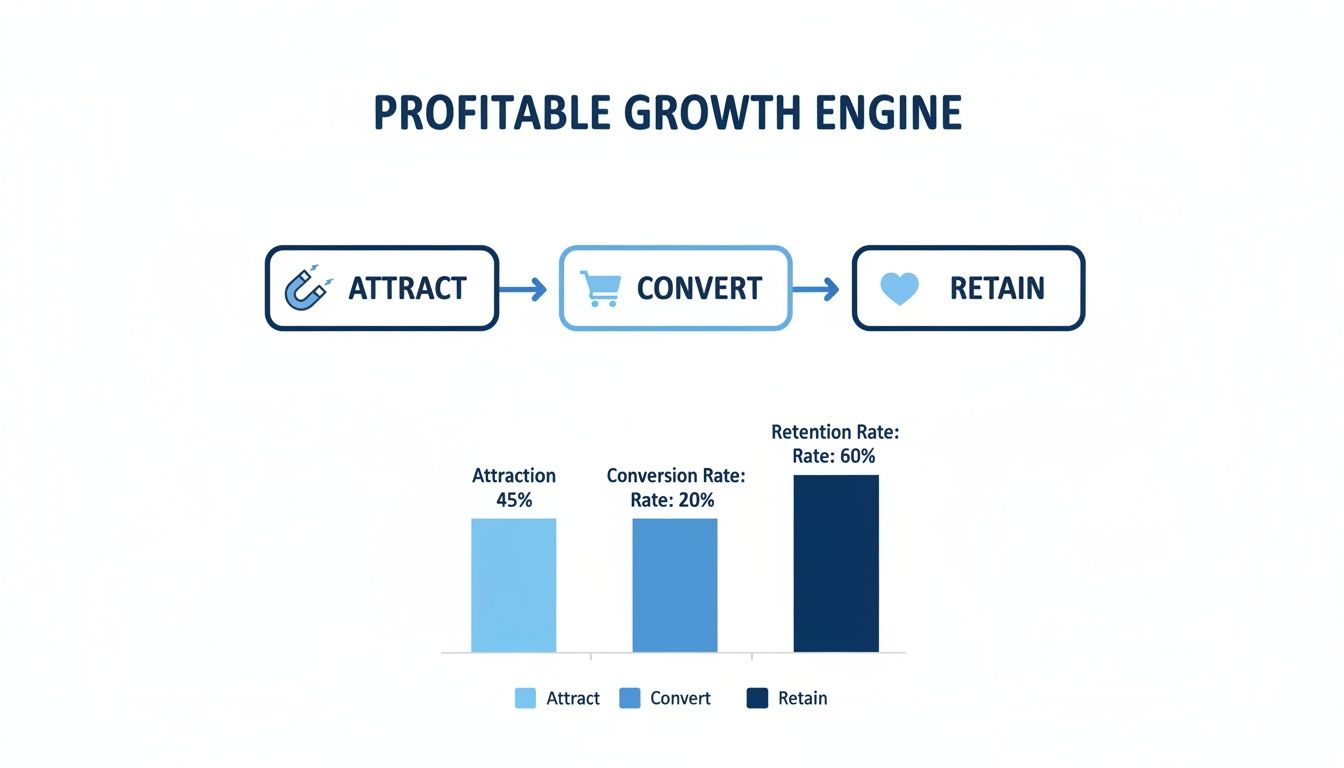
As you can see, a small lift in retention can have a massive impact on your bottom line, which is why it’s so critical to acquire customers who will stick around.
Understanding Customer Acquisition Cost (CAC)
Customer Acquisition Cost (CAC) is simply the total amount you spend on sales and marketing to convince one person to make their first purchase. It’s a brutally honest metric that answers the most critical question in e-commerce: “How much did we just pay to win that new customer?”
To work it out, you add up all your sales and marketing costs over a set period (say, a month) and divide that total by the number of new customers you brought in during that same time.
The CAC Formula: (Total Sales Costs + Total Marketing Costs) / Number of New Customers Acquired = CAC
And be honest with your costs. This isn’t just your ad spend. It should include everything—agency fees, content creation costs, software subscriptions, and even the salaries of your marketing team. An accurate CAC is your baseline for profitability.
The Importance of Customer Lifetime Value (LTV)
While CAC looks at the upfront cost, Customer Lifetime Value (LTV) flips the script to predict the total revenue you can expect to earn from a single customer over their entire relationship with your brand.
It forces you to stop thinking about a single transaction and start thinking about the long-term value of that relationship. A high LTV is a sign you’re acquiring the right kind of customers—the ones who come back, buy again, and become loyal fans.
A simple LTV formula multiplies your average sale value by the number of repeat purchases and the average time a customer stays with you. It shows you the real prize you’re chasing with every acquisition.
The LTV:CAC Ratio: Your Ultimate Health Check
Individually, CAC and LTV are useful snapshots. Together, they create the LTV to CAC ratio—arguably the single most important metric for any growing e-commerce brand. This simple ratio compares how much a customer is worth against how much they cost to acquire.
It’s your business model’s viability test, boiled down to a single number.
- A ratio below 1:1 means you’re actively losing money on every new customer. Ouch.
- A ratio of 1:1 means you’re just breaking even. You’re surviving, not thriving.
- A healthy ratio is typically considered 3:1 or higher. This means for every pound you spend, you get three pounds back over that customer’s lifetime. That’s a business built to last.
UK Customer Acquisition Cost (CAC) Benchmarks by Industry
Understanding your LTV:CAC ratio is crucial, especially as acquisition costs continue to climb. The direct-to-consumer market in the UK is growing fast, but this growth comes with fierce competition for eyeballs and ad space, forcing brands to get smarter. Knowing what’s “normal” for your industry provides essential context.
For instance, Shopify benchmarks reveal just how much CAC can vary, from around £16 for arts and crafts to a jaw-dropping £295 for electronics brands, often driven by higher price points and more complex marketing funnels. This huge variance is precisely why you need to know your own numbers inside and out.
| E-commerce Sector | Average CAC | Primary Cost Drivers |
|---|---|---|
| Fashion & Apparel | £25 - £50 | Ad spend (Meta, TikTok), influencer marketing, high return rates |
| Beauty & Cosmetics | £30 - £60 | Influencer collaborations, sampling programmes, high ad competition |
| Food & Beverage | £20 - £45 | Subscription models, paid social, high repeat purchase focus |
| Home Goods | £50 - £100 | Higher AOV, paid search (Google), longer consideration period |
| Electronics | £100 - £300+ | High-ticket items, complex funnels, affiliate marketing costs |
These figures aren’t set in stone, but they highlight the different financial realities across e-commerce. A brand selling £15 tea can’t afford the same CAC as one selling £1,500 sofas. Ultimately, the only benchmark that truly matters is your own LTV:CAC ratio.
Finding Customers in a Crowded Market
Knowing your metrics is one thing, but the next question is obvious: where do you actually find these customers? In a market saturated with noise, figuring out the right acquisition channels is the difference between blending in and breaking through. For any modern DTC brand, this means building a smart mix of paid, organic, and owned channels.
The goal isn’t to be everywhere at once. It’s about getting surgical. You need to pinpoint where your ideal customers spend their time and invest your budget there for the highest possible impact. This requires a real understanding of what each channel offers and how it fits with your brand.

A Modern Mix of Acquisition Channels
Think of your acquisition strategy like a balanced investment portfolio. Relying too heavily on a single channel is just plain risky; diversifying creates a much more resilient growth engine. Here’s how I break down the core channel types.
-
Paid Channels: These are the platforms where you pay for visibility. Think Google Ads, Meta (Facebook and Instagram) Ads, and TikTok Ads. Their strength is speed and precision; you can get in front of a very specific audience almost instantly. The catch? They require constant investment and optimisation to stay profitable. Turn off the tap, and the traffic stops.
-
Organic Channels: These channels pull customers in without a direct ad spend. The two heavyweights here are Search Engine Optimisation (SEO) and content marketing (like a blog or video series). They take a lot longer to build momentum, but they create a long-term, compounding asset that can drive traffic for years to come.
-
Owned Channels: These are the platforms you control directly, like your email list and SMS subscribers. Frankly, these are your most valuable channels. You have a direct line of communication with an audience that has already raised their hand, making conversions cheaper and far more reliable.
The Rising Cost of Getting Noticed
Choosing the right channels has become more critical than ever, mainly because costs are spiralling. Fierce competition for online ad space, coupled with stricter data privacy rules, has made every single click and conversion more expensive than it used to be.
In fact, the average customer acquisition cost (CAC) in the UK e-commerce sector has soared to $29 per new customer. That’s a massive 222% jump from the figures we saw just over a decade ago. This sharp increase makes it painfully clear why a blind, scattergun approach to marketing is a recipe for disaster.
This rising cost forces a strategic shift. Brands now have to focus on efficiency, which means truly understanding the nuances of each channel and how they all fit together. To find and engage potential buyers without breaking the bank, mastering modern sales prospecting best practices is essential for turning interest into actual revenue.
A successful acquisition strategy isn’t about spending more; it’s about spending smarter. It requires a deep understanding of channel dynamics, cost structures, and where your specific audience is most receptive to your message.
Ultimately, the best approach combines the immediate impact of paid ads with the sustainable, long-term growth of organic efforts, all while nurturing your most valuable asset—your owned audience. This integrated strategy helps you build a robust system for attracting customers that can withstand market shifts and rising costs.
How to Accurately Calculate Your Acquisition Costs
Moving from theory to practice is where you really get a grip on your growth. Nailing your Customer Acquisition Cost (CAC) is the first, most critical step. Thankfully, the basic formula is pretty simple. The hard part is being brutally honest and thorough with your numbers.
The fundamental formula is this:
(Total Marketing & Sales Spend / Number of New Customers Acquired) = CAC
Let’s break this down with a real-world example. Imagine a UK-based skincare brand wants to figure out its CAC for the month of April.
Identifying Your Total Spend
First, you’ve got to add up every single penny associated with your sales and marketing for that month. It’s so easy to just look at your ad spend, but that’s a rookie mistake. A proper calculation includes everything that had a hand in winning those new customers.
This means tallying up expenses like:
- Ad Spend: The cash you dropped on platforms like Meta Ads, Google Ads, and TikTok. Let’s say this was £5,000.
- Salaries: A portion of the salaries for your marketing team—the people actually running the acquisition engine. Let’s allocate £2,000.
- Tools & Software: The cost for your email platform, analytics tools, and any design software. This comes to £500.
- Content & Creative: Fees for freelance copywriters, photographers, or any agency help you brought in. Let’s add £1,000.
Add it all up, and the brand’s total acquisition spend for April is £8,500. If you want a more streamlined way to do this, our guide on finding the right customer acquisition cost calculator can help you pick a tool that fits your business.
Counting Your New Customers
Next up, you need the exact number of new customers you acquired during that same period. This distinction is vital. You have to exclude returning customers from this specific calculation, otherwise you’ll completely skew your CAC and think it’s lower than it is.
Let’s say our skincare brand brought in 250 brand-new customers in April.
With these two figures, the calculation is straightforward:
£8,500 (Total Spend) / 250 (New Customers) = £34 CAC
This means that, on average, the brand spent £34 to acquire each new customer in April.
This number gives you a clear, actionable baseline to work from. But here’s where it gets tricky for most brands: attribution. How do you know which channel or campaign actually deserves credit for the sale? Was it the first ad a customer saw, the last one they clicked, or the email they opened in between?
This is exactly why having a single source of truth for your data is non-negotiable. Trying to stitch together insights from messy spreadsheets or isolated platform dashboards is a recipe for bad data and even worse decisions. A unified view of performance is the only way to truly understand where your money is working hardest and where to invest it next.
Common Acquisition Mistakes and How to Fix Them
Knowing the definition of customer acquisition and its core metrics is one thing. Putting it all into practice without burning a pile of cash is another challenge entirely. I’ve seen countless DTC brands, all with the best intentions, fall into the same common traps that waste money and kill their momentum.
The good news is these mistakes are completely fixable. By spotting these pitfalls early, you can shift your strategy from just spending more to spending smarter. That’s how you make every marketing pound work towards profitable, sustainable growth.
Mistake 1: Obsessing Over Traffic Instead of Conversions
It’s so easy to get hooked on a rising traffic chart. More visitors feels like progress, right? But if those visitors aren’t actually buying anything, you’re just paying for window shoppers. The goal isn’t to attract eyeballs; it’s to attract the right eyeballs and actually convince them to pull out their wallets.
- The Fix: Get laser-focused on Conversion Rate Optimisation (CRO). Before you even think about upping your ad budget, take a hard look at your website’s user experience. Where are people dropping off? Run some A/B tests on your product pages. Is your checkout process clunky and complicated? A tiny 1% improvement in your conversion rate can often have a bigger bottom-line impact than a 20% jump in traffic.
Mistake 2: Neglecting Customer Retention
So many brands are relentlessly focused on the thrill of the chase—acquiring new customers—that they completely forget about the ones they already have. This is a massively expensive oversight. It costs far, far more to win over a new person than it does to convince an existing customer to buy from you again.
When you have a leaky bucket, with new customers pouring in the top as old ones drain out the bottom, profitable growth becomes nearly impossible.
Strong retention directly lowers the pressure on your acquisition efforts. Just look at the UK banking sector. A Q3 2024 analysis showed that leaders like Nationwide gained 2.3 new customers for every one they lost. That’s a masterclass in how retention fuels efficient growth. You can dig into more of that data on how leading UK banks compare on Statista.
The single most effective way to improve your customer acquisition model is to get better at keeping the customers you’ve already paid to acquire. Strong retention creates a stable foundation you can actually build on.
- The Fix: Build a real retention strategy. This isn’t just an afterthought. It could be a simple loyalty programme, personalised email campaigns based on past purchases, or genuinely exceptional customer service that turns a one-time buyer into a lifelong fan. Your goal is to build a relationship, not just process a transaction. For more practical advice, check out our guide on how to reduce customer acquisition cost by dialling in your retention.
Mistake 3: Scaling Ad Spend Prematurely
When you find an ad that works, it feels like you’ve struck gold. The temptation is to immediately dump as much money as you can behind it. But scaling too fast, before you have a proven and profitable funnel, is one of the quickest ways to burn through your entire marketing budget.
An ad that performs beautifully with a small, targeted audience often falls flat when you blast it out to a broader one.
- The Fix: Prove your unit economics first. Before you scale, make absolutely sure your LTV to CAC ratio is healthy for that specific channel—ideally 3:1 or better. Test your creative and audiences methodically. Increase your budget in small, controlled steps, watching your performance metrics like a hawk to ensure profitability doesn’t nosedive as you spend more. This disciplined approach protects your margins and builds a far more resilient acquisition engine for the long run.
Using AI to Get Smarter Acquisition Insights
Let’s be honest, manually tracking your acquisition performance is a painful, time-consuming chore. You’re juggling data from your Shopify store, Google Ads, Meta, and a half-dozen other platforms. The result? A fragmented, confusing picture that makes it nearly impossible to get a straight answer on how your business is actually growing.
This is where a modern approach completely changes the game. Instead of drowning in spreadsheets, you can use an AI data analyst to do the heavy lifting for you.

Automating Your Performance Reporting
Imagine just asking, “Which channel had the best LTV:CAC ratio last month?” and getting an instant, plain-English answer. That’s the idea. Tools like Menza plug directly into all your data sources to give you that kind of clarity in real-time.
Think of it this way: instead of spending hours exporting data and wrestling with pivot tables, you can spend that time making smart decisions. An AI analyst acts like a tireless team member, constantly monitoring performance so you don’t have to.
This isn’t about replacing your team; it’s about giving them superpowers.
For example, you could get a proactive alert the moment a channel’s CAC suddenly spikes, or when your website’s conversion rate takes an unexpected dip. This allows you to act fast, fix problems before they escalate, and seize opportunities as they emerge.
By turning complex datasets into clear, actionable advice, you can refine your strategies with confidence. Many CPG brands are already doing this, using ads data driving smarter CPG decisions to get ahead. It’s a fundamental shift from reactive analysis to proactive intelligence—the key to building a truly optimised and profitable acquisition model.
A Few Final Questions
As we wrap up, let’s tackle a couple of the most common questions I hear from founders when they start putting these ideas into practice. These are the sticking points that often come up in the real world.
What’s the Real Difference Between Customer Acquisition and Lead Generation?
It helps to think of lead generation as the first leg of a relay race. It’s all about attracting potential customers and getting them to raise their hand—maybe by signing up for a newsletter or downloading a guide. You’ve captured their interest and their email address.
Customer acquisition is the entire race, from that first flicker of interest all the way to the finish line: their first purchase. A lead is someone looking in the shop window; an acquired customer is someone who just walked out with a shopping bag. Lead gen gets you the audience, but acquisition turns that audience into revenue.
How Often Should I Actually Calculate My Customer Acquisition Cost?
For a stable, big-picture view of your business’s health, you should be calculating your blended CAC monthly. This gives you a consistent baseline and helps you spot worrying trends before they get out of hand.
But that’s only half the story. It’s just as crucial to calculate CAC for specific campaigns. Think of a Black Friday sale or a new product launch. This campaign-level view shows you the true profitability of individual marketing efforts, helping you figure out where to double down and what to cut.
A very low CAC isn’t always something to celebrate. It could mean you’re not investing enough in growth, or worse, you’re attracting low-quality customers who buy once and disappear. The real goal is a healthy LTV to CAC ratio (ideally 3:1 or better). That’s the proof you’re acquiring valuable customers profitably.
To stay ahead, a comprehensive guide to AI search engine optimization can provide smarter acquisition insights.
Ready to stop guessing and get clear answers about your acquisition performance? Menza connects to all your data sources to deliver real-time, plain-English insights, helping you make smarter, faster decisions that drive profitable growth. Learn more at menza.ai
Stop guessing. Start knowing.
Menza connects to your Shopify, Klaviyo, ad platforms, and 800+ other connections. Ask questions in plain English and get answers you can trust — no spreadsheets, no code, no waiting.