Master Your Growth With a Customer Acquisition Cost Calculator
A customer acquisition cost calculator is one of those fundamental tools that separates the brands that scale profitably from those that just… spend. It’s the simple, honest broker that tells you exactly how much it costs to bring a new person through your digital door.
By lining up your total sales and marketing spend against the number of new customers you’ve won, it cuts through the noise and reveals the true cost of your growth. That number is the key to smarter budgets and a strategy that actually works.
Why a CAC Calculator Is Non-Negotiable for UK Ecommerce
Let’s get real about what happens when you’re flying blind on Customer Acquisition Cost (CAC). For UK ecommerce brands, the current market is unforgiving. Operating without a firm grip on your CAC is like trying to navigate the London Underground during rush hour with a blindfold on. It’s chaotic, expensive, and you’ll almost certainly end up somewhere you didn’t want to be.
We’re not just talking about another spreadsheet here. This is a critical tool for survival. Knowing your CAC is what gives you the confidence to make the right calls when the pressure is on.
The Soaring Cost of Acquiring UK Customers
Let’s face it: getting new customers in the UK has never been more expensive. The latest data is pretty sobering. UK brands are now shelling out an average of £29 per new customer once you factor in marketing spend and returns.
That’s a staggering 222% increase compared to 2013.
Why the huge jump? A cocktail of sluggish economic growth, tighter data rules like GDPR, and brutal competition for the same ad space. For ecommerce brands specifically, Shopify’s internal data suggests the average CAC is even higher, sitting somewhere between £68-£78. You can find more insights on UK ecommerce CAC over on loyaltylion.com.
Without a precise CAC calculation, you’re not just guessing. You’re actively lighting your budget on fire, pouring it into channels that could be bleeding you dry without you even realising it.
From Reactive Spending to Proactive Strategy
Once you start tracking this metric, everything changes. Your entire approach shifts from being reactive and chaotic to strategic and deliberate. A solid customer acquisition cost calculator helps you:
- Optimise Ad Spend: Finally see with clarity which campaigns and channels are actually delivering customers at a price that makes sense for your business.
- Forecast Profitability: Get a real sense of whether your growth plans are financially sound before you commit another pound of your budget.
- Make Data-Driven Decisions: Confidently double down on the channels that are working and have the evidence to re-evaluate or cut the ones that aren’t.
Ultimately, a CAC calculator is what stops you from pouring money into a leaky bucket. It delivers the clarity you need to build a sustainable, profitable ecommerce business, even when the market feels tough.
Gathering the Right Data for an Accurate Calculation
Your customer acquisition cost calculator is a powerful tool, but its output is only as reliable as the data you feed it. Garbage in, garbage out. A miscalculation can send you chasing the wrong strategy, leading to poor budget allocation and missed opportunities. To get a number you can actually trust, you need to do a thorough audit of your expenses and customer data.
The process starts with identifying every single sales and marketing cost over a specific period, like a month or a quarter. This goes way beyond just your ad spend on platforms like Meta and Google. You need to account for every pound that contributes to winning new business.
Itemising Your True Acquisition Spend
So many businesses make the mistake of only including direct advertising costs. This gives them a dangerously incomplete picture of their real CAC, making their acquisition efforts look far more profitable than they actually are.
To avoid this trap, your list of expenses needs to be comprehensive. A complete cost audit should include:
- Team Salaries: The wages and commissions for your marketing and sales staff who work on acquisition.
- Software Subscriptions: All the tools you pay for—your CRM, email marketing platform, analytics software, and any SEO tools.
- Creative & Content Production: Any fees paid to freelancers or agencies for creating ad visuals, writing blog posts, or producing video content.
- External Partner Fees: Retainers or project fees for any marketing, PR, or sales agencies you work with.
This level of detail ensures you’re calculating a fully loaded CAC, which reflects the true total investment it takes to land a new customer. It’s a much more honest metric than one based solely on ad spend, just like a complete understanding of ROAS is necessary to judge campaign performance.
Defining and Counting New Customers
Just as crucial as gathering your costs is getting your customer count right. The key word here is new. Your calculation must strictly include only customers making their very first purchase during your chosen timeframe.
Including returning customers in your ‘new customer’ count is one of the most common and misleading mistakes out there. It will artificially deflate your CAC, making your marketing seem far more efficient than it is and masking potential problems in your acquisition funnel.
To get this right, you need to filter your customer list meticulously. Most e-commerce platforms like Shopify or your CRM will allow you to segment customers by their order history. You’ll want to create a filter that isolates customers whose first order date falls within the period you are analysing.
This precise count, when divided into your total costs, gives you an accurate and actionable CAC. It’s the number you can actually use to make genuinely smart growth decisions.
How to Build Your Own CAC Calculator
Alright, let’s move beyond the theory and get our hands dirty. Building a customer acquisition cost calculator that actually gives you useful insights doesn’t require some fancy, expensive software. Honestly, you can build a seriously powerful version right in a spreadsheet. This simple tool will become your command centre for understanding if your marketing is actually making you money.
The core formula is simple enough: divide your Total Sales & Marketing Costs by the Number of New Customers you brought in during a certain period. But a truly useful calculator goes deeper, letting you slice and dice the data to find the real story. Before you start building, it’s worth getting your head around how to calculate your Cost Per Acquisition (CPA), as the two concepts are closely related.
This flowchart gives you a high-level view of the data you’ll need to pull together.
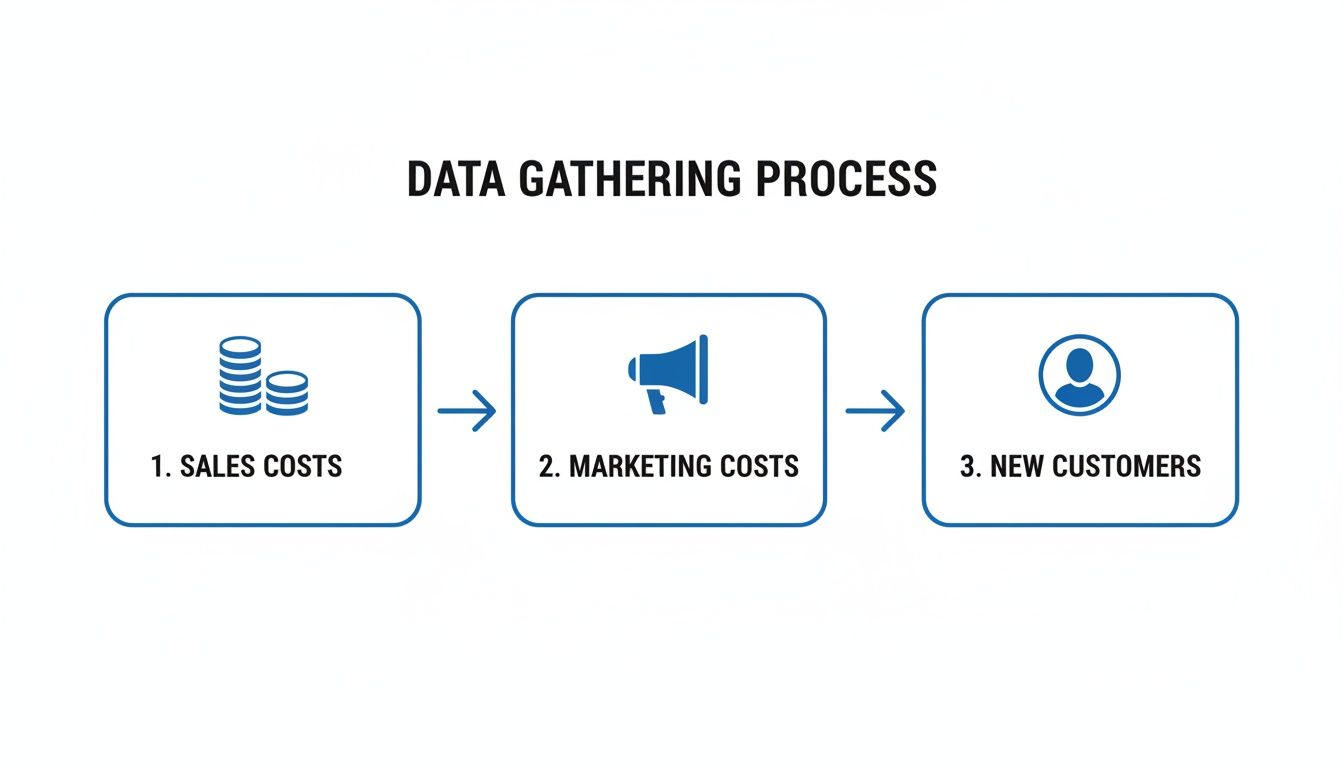
It boils down to two main buckets: adding up all the money you’re spending to get customers, and then dividing it by the number of new customers you actually got. Simple on the surface, but the magic is in the details.
Structuring Your Calculator Spreadsheet
The key to making this a tool you’ll actually use is organisation. A clean, logical structure makes the calculator easy to update and less of a chore to maintain.
Start by setting up your columns. You’ll want a dedicated spot for each piece of the puzzle. Here’s a practical layout to get you started:
- Time Period: (e.g., January 2024, Q1 2024)
- Total Marketing Spend: Every penny from ad platforms, content creation, agency fees, etc.
- Total Sales Spend: Salaries, commissions, and software for your sales team.
- Total Costs: A simple sum of your marketing and sales spend.
- New Customers Acquired: The number of first-time buyers in that same period.
- Overall CAC: The final number (Total Costs / New Customers).
The real power of a custom calculator comes from segmentation. By adding rows for each marketing channel, you can compare the cost to acquire a customer from TikTok versus one from Google Search. This is where you find out which channels are truly driving efficient growth.
Segmenting by Channel and Timeframe
A blended, overall CAC is a decent starting point, but the actionable insights come from breaking it down. You can easily create separate sections or even different tabs in your spreadsheet to calculate CAC for each marketing channel—Meta Ads, Google Ads, Influencer Marketing, you name it.
This channel-specific view is absolutely critical for allocating your budget smartly. You might discover that while Google Ads brings in a high volume of new customers, its CAC is double that of your influencer campaigns. That single insight tells you exactly where to shift your budget for more profitable growth.
It’s also smart to calculate your CAC across different timeframes—monthly, quarterly, and annually. This helps you spot trends. Is your CAC creeping up? A sudden spike in monthly CAC could signal that a campaign is getting tired or that a new competitor just jacked up auction prices. Catching that early lets you fix it before it becomes a long-term problem.
UK E-commerce CAC Benchmarks by Industry
Knowing your own numbers is one thing, but understanding how they stack up against the competition provides crucial context. A “good” CAC is relative. Here’s a look at some typical CAC ranges across the UK e-commerce landscape to help you benchmark your own performance.
| Industry | Average CAC Range (£) |
|---|---|
| Fashion & Apparel | £95 - £165 |
| Food & Beverage | £30 - £80 |
| Home Goods | £75 - £140 |
| Beauty & Cosmetics | £50 - £110 |
| Electronics | £76 - £120 |
| Luxury Goods | £175+ |
As you can see, the variation is huge. Electronics retailers face high costs due to price sensitivity and competition, while food and beverage brands often see lower costs thanks to higher repeat purchase rates. A fashion brand might spend around £129 to get a new customer, but a luxury brand could easily spend over £175. Knowing where your business fits in helps you set realistic targets and judge whether your spending is in line with industry norms.
Turning Your CAC Into Smarter Growth Decisions
Calculating your Customer Acquisition Cost is a fantastic starting point, but the number itself doesn’t tell you the whole story. Its real power comes alive when you put it in context with other key business metrics.
Knowing your CAC is like knowing how much fuel you’re putting in your car; to understand if you’re on a profitable journey, you need to know how far that fuel will actually take you.
This is where the real analysis begins. A standalone CAC figure can be seriously misleading. A CAC of £100 might seem high, but if that customer goes on to spend £1,000 with you over the next year, it’s an incredible investment. On the flip side, a £10 CAC feels great until you realise that customer churns immediately and never comes back.
The LTV to CAC Ratio Explained
The most important companion metric for CAC is Customer Lifetime Value (LTV). Simply put, LTV is the total revenue you can reasonably expect from a single customer throughout their entire relationship with your brand.
When you compare LTV to what you spent to acquire them, you get the LTV:CAC ratio—arguably the single most important metric for gauging the long-term health and scalability of your business.
A healthy LTV:CAC ratio is your green light for growth. The generally accepted benchmark for a sustainable business is a ratio of at least 3:1. This means for every pound you spend on acquisition, you get three pounds back over that customer’s lifetime.
A ratio below 3:1 suggests you’re overspending and may be on an unprofitable path. A ratio significantly higher, like 5:1 or more, could actually mean you’re underspending on marketing and leaving growth opportunities on the table.
Understanding LTV is so critical that we’ve dedicated an entire post to it. You can learn more about how to calculate customer lifetime value in our guide.
Calculating Your CAC Payback Period
Another crucial piece of the puzzle is the CAC Payback Period. This metric tells you exactly how many months it takes for you to earn back the money you spent to acquire a new customer. In a world where cash flow is king, this is a metric you absolutely cannot afford to ignore.
A shorter payback period means you can reinvest your capital into growth much faster. For subscription-based e-commerce businesses, a payback period of under 12 months is often considered a strong benchmark.
To calculate it, you use this formula:
CAC / (Average Revenue Per Account x Gross Margin %)
Let’s walk through an example. Your CAC is £150. Your average new customer pays £50 per month, and your gross margin is a healthy 80%.
- First, find your monthly margin per customer: £50 * 0.80 = £40
- Then, calculate the payback period: £150 / £40 = 3.75 months
This tells you that your business becomes profitable on a new customer in just under four months. Armed with this knowledge, you can make much smarter decisions about how aggressively you can afford to spend on growth. Getting a handle on your CAC is foundational to measuring marketing effectiveness using Excel and AI and ensuring every pound spent contributes to sustainable expansion.
Common Mistakes to Avoid When Calculating CAC
Even the best customer acquisition cost calculator is useless if you feed it the wrong information. Your final CAC number is only as good as the data and logic behind it, and it’s surprisingly easy to make small mistakes that compound into a seriously flawed metric.
When your CAC is wrong, you make bad decisions. You overspend on channels that aren’t working or cut the budget for campaigns that actually are. Getting this right isn’t just about maths; it’s about building confidence in the numbers that guide your growth.
Think of this as a troubleshooting guide. I’ve seen these same mistakes trip up countless brands. Steer clear of them, and you can be sure the CAC you’re looking at is a true reflection of your business.
Mixing Up New and Returning Customers
This is, without a doubt, the most frequent and damaging mistake I see. The entire point of CAC is to understand what it costs to acquire a new customer. If you include sales from your existing, loyal customers, you will artificially crush your CAC and make your marketing look far more efficient than it really is.
It’s an easy trap to fall into, especially if you’re just glancing at top-line customer numbers in Shopify. You have to be meticulous here. Filter your customer list to isolate only those who made their very first purchase within the period you’re measuring. This distinction is non-negotiable for an accurate calculation.
A CAC that includes returning customers isn’t a CAC at all—it’s a blended cost that masks the true performance of your acquisition engine. This can lead you to pour money into expensive campaigns under the false impression they are profitable.
Ignoring the Hidden Costs
Another classic error is calculating CAC using only your direct ad spend from platforms like Meta or Google. This gives you a dangerously incomplete picture. The only number that really matters is your fully loaded CAC, because it’s the only one that reflects the true cost of your acquisition engine.
To get it right, you have to account for all the associated costs—the ones that are easy to forget but can have a massive impact on the final number.
- Salaries and Wages: A portion of the salaries for your marketing and sales teams.
- Software Subscriptions: The cost of your CRM, email marketing tools, analytics platforms, and other marketing tech.
- Creative Production: Fees for designers, copywriters, or agencies making your ad content.
- Agency Retainers: Any fees paid to external marketing or PR partners involved in acquisition.
Failing to include these costs means you’re underestimating your CAC, sometimes by a huge margin.
Misattributing Costs and Timeframes
Accuracy depends on correctly lining up your costs with the period in which the customers were actually acquired. For example, don’t attribute the cost of a big Q1 campaign to customers who signed up in Q2. That kind of temporal mismatch will completely skew your results and make it impossible to analyse trends properly.
Similarly, be careful about how you attribute costs from broad, brand-building activities. That spend has a real, long-term impact, but lumping it directly into a short-term acquisition campaign will distort your channel-specific CAC. It’s better to allocate it carefully or analyse it separately.
Focusing on precision here ensures your calculations are both accurate and genuinely actionable—which, by the way, is a key part of any successful Shopify conversion rate optimisation strategy.
Beyond Spreadsheets: Automating Your CAC Monitoring
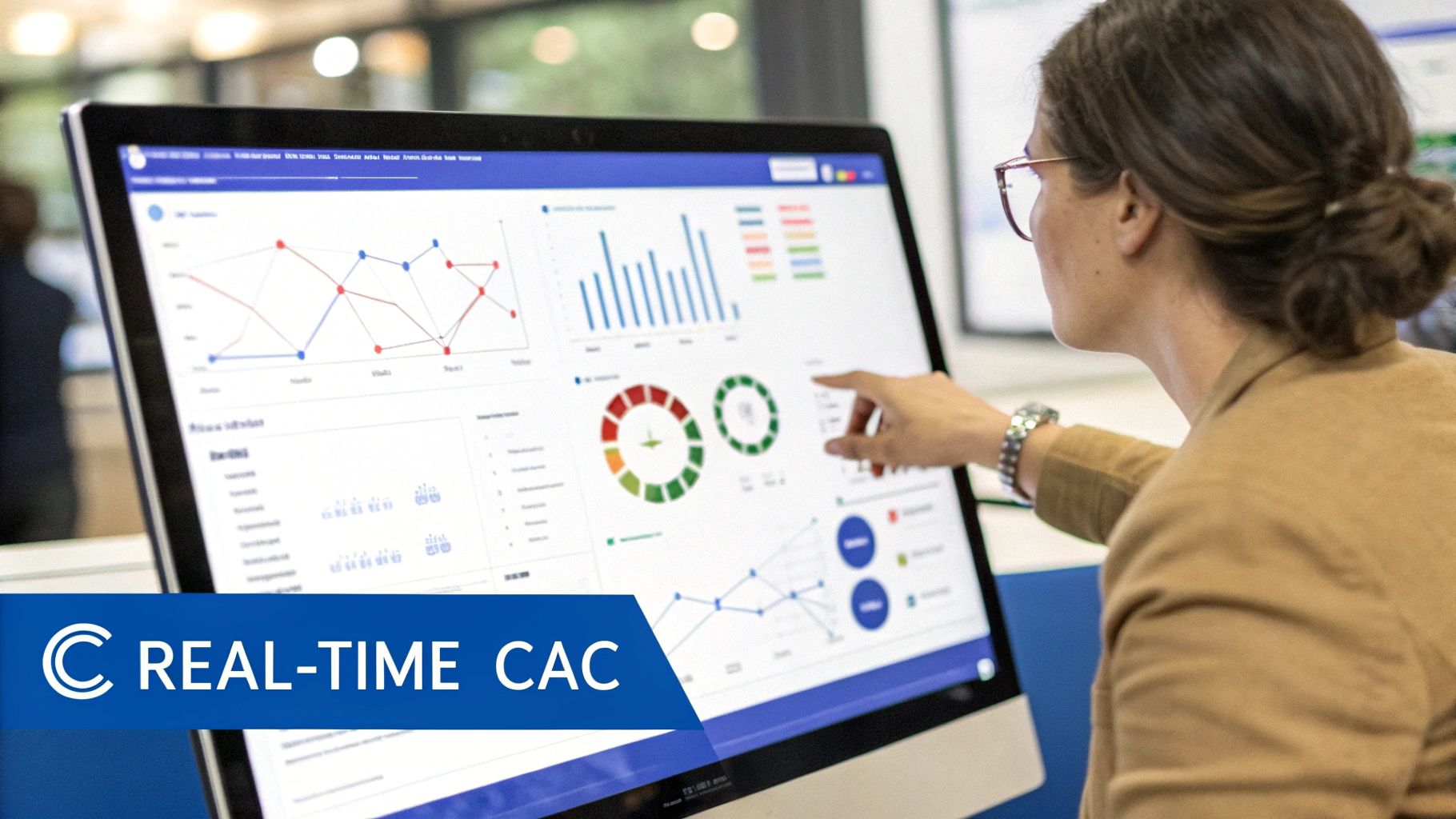
A spreadsheet calculator is a great place to start with CAC, but it has a very short shelf life. I’ve seen countless teams get stuck in a painful cycle of manually pulling data, updating formulas, and triple-checking for errors. It’s a chore that becomes impossible to sustain as you scale.
Worse, the numbers are already out of date the moment you close the file. Your critical metric becomes a historical report, telling you what was true yesterday, not what’s happening now. This is where automation becomes a total game-changer.
Moving beyond static calculators lets you turn CAC from a periodic reporting task into a proactive, real-time lever for managing your business. The goal is to get an always-on, accurate view of your acquisition health, without any of the manual drudgery.
Connecting Your Data for a Live View
The real power kicks in when you connect directly to your data sources. A platform built for this can integrate with the entire ecosystem of tools you already use, creating a single, reliable source of truth.
This means linking to everything from your core business platforms to your marketing channels:
- E-commerce Platform: Your Shopify or BigCommerce store.
- Web Analytics: Tools like Google Analytics.
- Advertising Platforms: Meta Ads, Google Ads, TikTok Ads, and so on.
- CRM and Email Tools: Systems like HubSpot or Klaviyo.
By pulling data directly from the source, you eliminate the risk of copy-paste errors and ensure your CAC calculation is always based on the latest information. It moves your analysis from a monthly or quarterly exercise to something you can check on demand.
This shift is fundamental. Instead of asking, “What was our CAC last month?” you can confidently ask, “What is our CAC right now?” This immediacy allows you to spot trends, identify problems, and seize opportunities much faster than any manual process ever could.
Turning Questions into Instant Answers
Ultimately, the point of automating your CAC monitoring is to get fast, reliable answers to your most pressing business questions. Imagine being able to ask, in plain English, “What was our CAC from Facebook ads last month compared to Google?” and getting an instant, accurate answer without touching a single spreadsheet.
This conversational approach brings data to everyone. Your marketing manager, your operations lead, and even you as the founder can access critical performance insights without needing to be a data analyst. The automation handles all the complex work of gathering, cleaning, and calculating in the background.
This capability transforms CAC from a simple metric into a dynamic tool for decision-making. You can set up alerts to be notified if CAC for a specific channel suddenly spikes, or schedule recurring reports that land in your inbox every Monday morning. It frees up your team from the manual labour of reporting so they can focus on what actually matters—using the insights to grow the business more profitably.
Ready to move beyond manual spreadsheets and get real-time, trustworthy answers about your business performance? Menza connects to your entire data stack, allowing you to ask any question about your marketing, customers, or finances and get an instant, AI-powered analysis.
Discover how Menza can automate your insights today
Stop guessing. Start knowing.
Menza connects to your Shopify, Klaviyo, ad platforms, and 650+ other data sources. Ask questions in plain English and get answers you can trust — no spreadsheets, no code, no waiting.